A TEENAGER TRIED TO HUMILIATE ME ON A CROWDED BUS—THEN I SHOWED HIM THE NAMES INSIDE MY VETERAN CAP
Chapter 1 1/7
The Riding Crop That Never Landed
MY MAID SAID MY FIANCÉE KNEW WHERE MY MOTHER WAS BURIED—AND THE SECRET INSIDE MY OWN HOUSE HAD BEEN WAITING EIGHTEEN YEARS
The riding crop was already coming down when I caught it in my hand.
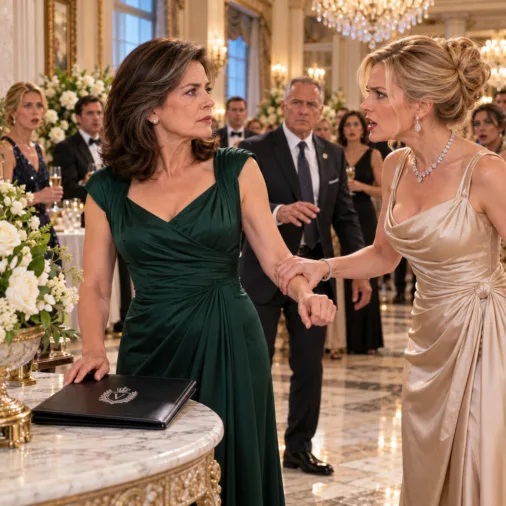
For one sharp second, nobody in the front hall of my house breathed. Victoria stood two feet from me with her arm still raised, her face bright with anger and then suddenly empty with shock. Mara, the quiet young maid she had been threatening, stood beside the grand staircase with both hands folded at her waist as if she could make herself disappear by standing perfectly still. I looked at the thin strip of leather stretched between Victoria’s fingers and mine, and something inside me went colder than the marble beneath our feet.
“Put it down,” I said.
Victoria stared at me. “Alessandro, I can explain.”
“I didn’t ask for an explanation.”
Her mouth tightened. Behind her, four members of the household staff had stopped pretending not to watch. One of the kitchen assistants held a silver tray against her chest; the butler stood near the library doors; two housekeepers had gone pale. I had spent most of my adult life watching powerful men recognize the exact moment when a room no longer belonged to them, and I saw that same recognition pass through Victoria’s eyes.
“She disrespected me,” she said. “She spilled red wine on the dress I was wearing for the luncheon, and then she stood there like I was the one who had done something wrong.”
Mara’s gaze stayed lowered. “I apologized, ma’am.”
Victoria snapped her head toward her. “Don’t speak unless someone asks you.”
That was enough.
I took the crop from Victoria’s hand and bent it hard across my palm. The leather-wrapped shaft broke with a dry crack, not loud enough to be dramatic but loud enough to make everyone in the hall flinch. I dropped both pieces onto the entry table between a crystal vase and a stack of unopened invitations for the wedding Victoria and I were supposed to have in six weeks.
“You’re defending a servant?” Victoria asked.
I turned to Mara instead. “Did she hurt you?”
“No, sir.”
It was a lie. I knew lies. I had built half my life around listening for the pause before one, the breath that changed, the eyes that moved toward an exit. Mara’s voice was steady, but her right hand had curled around her left wrist beneath the cuff of her black uniform, and there was an old fear in her posture that had nothing to do with spilling wine.
“You’re lying,” I said.
Her head came up.
That was the first time I truly looked at her.
Mara had worked in the house for nearly two years. I knew her name because I insisted on knowing the names of people who worked under my roof, but I could not have told anyone what she liked to eat, where she came from, whether she had brothers, or why she never joined the other staff members when they laughed in the back corridor after dinner service. I knew she was punctual, quiet, careful with fragile things, and almost impossible to provoke. I also knew that Victoria disliked her more than she disliked any other employee, though until that moment I had mistaken it for ordinary cruelty.
Mara’s eyes were dark brown.
My mother’s had been the same color.
The thought came so suddenly that I almost rejected it before it finished forming.
Mara took one backward step. As she moved, the collar of her uniform shifted and a thin silver chain slipped free. Something small caught the light against her throat.
A pendant.
I stopped breathing.
It was no bigger than my thumbnail, oval at the edges, with a tiny bird engraved over three narrow lines that looked like waves. The silver was worn smooth on one side from years of being touched. I had seen that symbol every morning of my childhood until I was twenty-one years old, and then I had never seen it again.
My mother had worn the same pendant the night she disappeared.
“Where did you get that?” I asked.
Mara’s hand flew to her throat.
Victoria looked from me to the pendant. “Alessandro, what is this?”
I ignored her.
“Mara. Where did you get it?”
Her face changed. The fear that had been contained behind her expression stepped forward all at once.
“It belonged to my mother.”
The front hall seemed to tilt around me.
“What was her name?”
She hesitated.
I took one slow step closer, then stopped when I saw her shoulders stiffen. I had no intention of frightening her, but people had been frightened of me for so long that I sometimes forgot I carried that fear into a room before I said a word.
“What was your mother’s name?” I repeated.
Mara looked at Victoria. Then at the upstairs landing. Then, finally, at me.
“Isabella.”
My mother’s name.
The world did not explode. No one shouted. The house did not shake.
I simply stood there while eighteen years of certainty cracked open inside my chest.
Isabella Romano had vanished on a rainy October night when I was twenty-one. The men around my father had blamed the Moretti family before sunrise. By the end of that week, two old alliances had collapsed. By the end of that year, the city had lived through the ugliest feud our family had ever known. People whispered about my mother’s death for years even though no body had ever been recovered, and everyone who loved me had eventually given me the same advice.
Let the dead stay dead.
I had obeyed.
Now a maid in my house was wearing my mother’s pendant.
Victoria’s face had gone pale.
“Alessandro,” she said softly, “don’t do this in front of the staff.”
I looked at her.
She had made the mistake of sounding afraid.
Mara noticed it too.
“What was your mother’s full name?” I asked.
Her fingers closed around the pendant until her knuckles whitened.
“I can’t tell you.”
“Why not?”
“Because she told me never to say it inside this house.”
Every person in the hall went still.
I heard the faint ticking of the tall clock beside the library. I heard a delivery truck somewhere beyond the gates. I heard Victoria draw one careful breath.
“Why?” I asked.
Mara swallowed.
“Because the person who killed her still lives here.”
The words landed harder than any gunshot could have.
Victoria took one step backward.
I saw it.
So did Mara.
I turned slowly toward the upper floors, toward the west wing where my uncle Enzo had lived for most of my life, toward my father’s old office, toward rooms that had been locked since my mother disappeared. For the first time, I understood the difference between owning a house and knowing what had happened inside it.
“Mara,” I said, “look at me.”
She did.
“If you know something about my mother, you tell me now.”
Her eyes filled, but she refused to let the tears fall.
“Sir… your fiancée knows where my mother is buried.”
I looked at Victoria.
She opened her mouth.
Nothing came out.
I had known Victoria Bellini for eight years. I had trusted her for five. I had been engaged to her for fourteen months. I had listened to her talk about flowers, guest lists, property, family alliances, and the kind of future she thought we would have after the wedding.
I had never once heard her say my mother’s name.
“Is that true?” I asked.
“No.”
The answer came too fast.
I felt the entire hall change around us.
Victoria tried again. “No, of course not. She’s manipulating you. You don’t even know who she is.”
I looked at Mara.
“No,” I said. “I don’t.”
Then I looked at the broken riding crop on the table.
“But I’m going to.”
A door opened above us.
Slow footsteps crossed the upper landing.
My uncle Enzo appeared at the top of the staircase in a dark morning jacket, one hand resting lightly on the carved banister. He was sixty-eight, silver-haired, dignified, and still capable of making veteran men straighten when he entered a room. After my father died, Enzo had become the closest thing I had to a second father.
His gaze moved from the broken crop to Victoria’s face.
Then to Mara.
Then to the pendant at her throat.
For the first time in my life, I saw my uncle lose control of his expression.
Only for a second.
But I saw it.
“Alessandro,” he said, “send the girl away.”
Mara stepped closer to the wall.
“Why?” I asked.
Enzo’s face smoothed over. “Because whatever game she is playing has already gone too far.”
Mara looked at me then, and something in her fear hardened into decision.
“My mother told me there would be one moment when I had to decide whether you were like him,” she said.
Enzo’s hand tightened on the banister.
“Like who?” I asked.
Mara lifted her chin.
“The man who taught you to call him family.”