THEY TOLD ME TO RENT A ROOM AND LEAVE THE HOUSE I’D OWNED FOR THIRTY-SEVEN YEARS. THEN I PUT THEIR OWN SIGNATURES ON THE TABLE.
Chapter 1 1/6
The Night They Asked Me to Leave
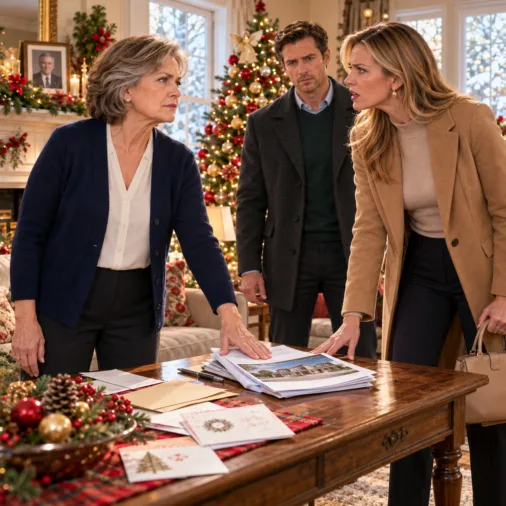
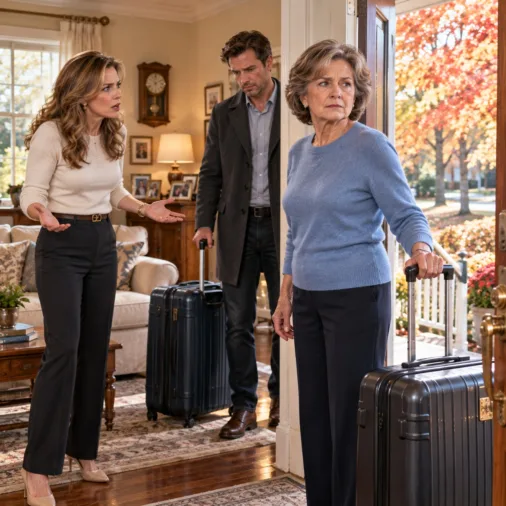
My daughter-in-law told me to rent a room and leave the house where I had buried thirty-seven years of my life, and my son sat three feet away and nodded as if she were discussing where to move a lamp.
That was the moment something inside me broke.
It was also the moment I finally became still enough to see exactly what they had been doing.
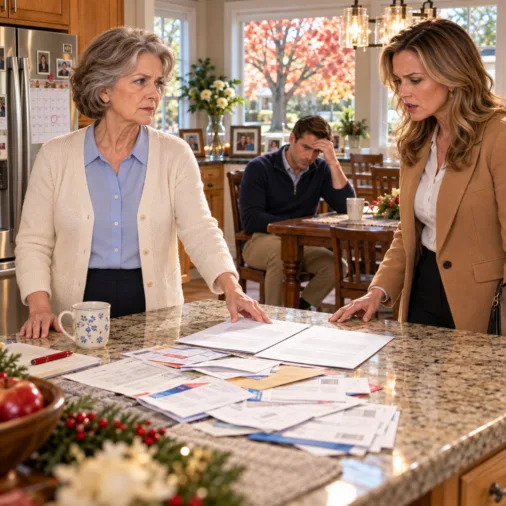
Ashley stood at the far end of my kitchen island with one hand wrapped around a glass of white wine and the other resting on the quartz countertop she had spent six months complaining needed to be replaced. David sat at the breakfast table with his elbows on his knees, staring at the floor.
“This arrangement isn’t working anymore,” Ashley said.
I looked at her.
The clock above the pantry read 7:42 p.m.
Outside the window, rain tapped against the glass, darkening the brick patio Tom had laid himself one summer when David was nine. The roses Tom planted along the fence were only bare October stems now, but I could still picture him out there in an old gray T-shirt, cursing at the clay soil while insisting he knew exactly what he was doing.
I turned my eyes back to my daughter-in-law.
“What arrangement?”
Ashley exhaled as though I were making a difficult conversation harder than it needed to be.
“Us living together.”
“You mean you and David living here?”
Her mouth tightened.
“You know what I mean, Margaret.”
I did.
That was the problem.
I knew exactly what she meant.
Three years earlier, when David called me and said their rent had gone up again and they were trying to save for a home, I had not hesitated.
“Come here,” I told him. “Stay as long as you need.”
I had two empty bedrooms, a finished basement, and a house that had become painfully quiet after Tom died.
At the time, I told myself it would be good for all of us.
I would have company.
They would save money.
David would have room to breathe after years of student loans and apartment leases.
Family helped family.
At least, that was what I still believed then.
Ashley set her wine down.
“David and I need our own space.”
I almost laughed.
“You have the entire second floor except my bedroom.”
“That’s not what I mean.”
“Then explain it.”
She glanced at David.
He finally looked up.
That hurt more than anything she could have said.
My son had Tom’s eyes.
Same hazel color.
Same slight crease between his eyebrows when he was nervous.
But that night there was something in his face I had never seen in Tom.
Cowardice.
“Mom,” he said quietly, “maybe it would be easier if you found somewhere smaller.”
The room went very quiet.
I stared at him.
“Somewhere smaller.”
He swallowed.
“You don’t really need all this space.”
For a few seconds, I could not hear the rain anymore.
I heard another sound instead.
A baby crying at two in the morning.
David’s first fever.
His sneakers pounding down the hallway when he was seven.
The thump of a basketball against the garage door despite my repeated warnings.
Tom laughing from the living room.
The silence after the funeral.
This house was not a collection of oversized rooms I no longer “needed.”
It was where I had survived almost everything that had ever mattered to me.
I had been twenty-six when Tom and I bought it.
We barely qualified for the mortgage.
He worked maintenance at a manufacturing plant, and I handled payroll for a regional insurance company. For years, every extra dollar went into the house.
A new roof.
New plumbing.
A furnace.
College savings.
Then Tom died at fifty-two after a sudden heart attack in the parking lot of a hardware store.
David was fifteen.
From that day forward, there were no longer two incomes.
There was mine.
I worked my regular accounting job during the week and did bookkeeping for small businesses at night.
I paid the mortgage.
I paid the taxes.
I paid for David’s braces, his first used Honda, his college application fees, and every expense I could manage without telling him how frightened I sometimes was.
I wanted him to believe that losing his father had not destroyed his future.
And now my son was sitting in the kitchen his father had helped remodel, telling me I did not need the house we had fought to keep.
Ashley folded her arms.
“We looked at rentals for you.”
That surprised me enough to make me blink.
“You did what?”
“There’s a place about twelve minutes away. A woman is renting a furnished room. Private bathroom. Utilities included.”
For the first time that evening, anger cut through the shock.
“A room.”
Ashley nodded as if she were offering something generous.
“It’s very nice.”
“How much?”
“Eleven hundred.”
I looked at David.
“You want me to pay eleven hundred dollars a month to live in someone else’s spare bedroom so the two of you can stay here?”
His face flushed.
“Mom, nobody is trying to hurt you.”
Ashley stepped in immediately.
“We’d take over the household expenses.”
“What household expenses?”
“The taxes. Insurance. Maintenance.”
“You mean the things I currently pay?”
Ashley’s jaw moved.
“We would obviously take responsibility once you moved.”
There it was.
Not concern.
Not practicality.
Possession.
I had heard it two months earlier without letting myself understand the full meaning.
I had come downstairs late one night because I forgot my reading glasses in the living room. Before I reached the bottom step, I heard Ashley talking in a low voice.
“Once we get her out, we can renovate everything.”
I stopped.
David said something too quietly for me to hear.
Ashley replied, “This place is worth at least eight hundred thousand. We would be idiots not to use it.”
I stood in the dark stairwell, one hand around the banister.
I waited for David to say, It isn’t ours.
I waited for him to say, That’s my mother’s home.
I waited for anything.
He said nothing.
At the time, I walked back upstairs without my glasses.
For two months, I convinced myself I had misunderstood.
That evening in the kitchen, I realized I had understood perfectly.
Ashley leaned toward me.
“You’d probably be happier without all the upkeep.”
I studied her face.
Then I studied my son.
I could have shouted.
I could have reminded him of every sacrifice I had made.
I could have thrown them out that minute.
Instead, something quieter happened inside me.
My grief hardened into clarity.
“I see,” I said.
Ashley looked almost startled.
David raised his head.
“You do?”
“Yes.”
I stood.
“I’ll start looking.”
The relief on Ashley’s face was so immediate that it confirmed everything.
“Thank you,” she said. “I knew you’d be reasonable.”
Reasonable.
I smiled.
Not because anything was funny.
Because my mother used to tell me that when someone mistakes your kindness for weakness, the worst thing you can do is argue with them before you know exactly where you stand.
“I’m tired,” I said. “Good night.”
I climbed the stairs slowly.
Behind me, Ashley began talking about paint colors before I reached the landing.
I heard the word “open concept.”
Then “resale.”
Then David murmuring something I could not make out.
I entered my bedroom and shut the door.
For several seconds I simply stood there.
Tom’s photograph sat on my dresser.
He was forty-eight in the picture, smiling into the sun at Lake Michigan.
I picked it up.
“You would have said something,” I whispered.
Then I corrected myself.
“No. You would have stopped this long before tonight.”
I put the photograph down and crossed to my jewelry box.
It was an old walnut box Tom gave me for our twentieth anniversary. Inside were his wedding ring, a pair of pearl earrings, David’s first lock of hair in a tiny envelope, and a gold bracelet I rarely wore.
I lifted the removable velvet tray.
Underneath it lay a large cream envelope.
I had not opened it in years.
My hands were steady.
Inside was the deed recorded after Tom’s estate had been settled.
I unfolded it on the bed.
There was my name.
MARGARET ANNE SULLIVAN.
Sole owner.
No David.
No Ashley.
No transfer.
No promise.
No mystery.
I sat on the edge of the bed and read it twice anyway.
Then I reached farther into the envelope.
That was when I found the second document.
I had nearly forgotten about it.
Three years earlier, before David and Ashley moved in, my old friend Robert Chen had insisted I protect myself.
Robert and I had worked together at the insurance company before he went back to law school. When I told him I was letting David and Ashley stay rent-free, he had given me the kind of look accountants give people who say they do not need receipts.
“Margaret, family is exactly why you put things in writing,” he told me.
I resisted.
“They’re my son and daughter-in-law.”
“And if everything goes well, the paper never matters.”
Eventually I agreed.
The document was simple.
A temporary occupancy agreement.
It said David and Ashley were permitted to live in the property without rent while saving for their own residence. Their occupancy did not create ownership, equity, title, or any future claim to the property. Any improvements required my written approval. Either side could end the arrangement with thirty days’ written notice, subject to applicable law.
I remembered Ashley laughing when she signed it.
“This is so formal.”
David had laughed too.
“Mom’s accountant brain.”
I had signed last.
Now I looked at all three signatures.
My smile disappeared.
They had not merely forgotten whose house it was.
They had forgotten what they had already agreed to.
The next morning I woke before six.
I made coffee.
Ashley came downstairs at seven wearing workout clothes and carrying her phone.
She smiled at me.
“Did you sleep okay?”
“Very well.”
“Good.”
She opened the refrigerator.
“I can send you the listing for that room.”
“No hurry.”
Her smile widened.
“I think you’ll like it.”
“I’m sure you do.”
She paused for half a second.
Then she went back to the refrigerator.
At eight-thirty, I drove downtown.
First I went to the county records office and obtained a certified copy of my deed.
Then I requested copies of the relevant property tax history.
After that, I stopped at my bank and printed records showing the mortgage payments I had made until the loan was satisfied six years earlier.
By noon I had a folder thick enough to make my shoulder ache.
At twelve-thirty I called Robert.
He answered on the second ring.
“Margaret Sullivan. Either you’re inviting me to lunch or somebody finally ignored the advice I gave you.”
“Both, possibly.”
His voice changed.
“What happened?”
“My son and his wife have decided I should move out of my house.”
There was a pause.
“Your house.”
“Yes.”
“The one you own.”
“Yes.”
“The one where I made them sign an occupancy agreement.”
I smiled despite myself.
“That one.”
“Lunch is on me.”
Robert was sixty-five now, silver-haired and precise, with the calm voice of a man who had spent decades watching people make emotional decisions about expensive things.
We met at a small Thai restaurant across from his office.
I told him everything.
He did not interrupt until I described overhearing Ashley say, “Once we get her out.”
Then he set his fork down.
“Do they believe David inherited part of the property when Tom died?”
“I don’t know what they believe.”
“Has David ever been on title?”
“No.”
“Have you ever signed anything suggesting he would receive ownership?”
“No.”
“Have they paid you rent?”
“No.”
“Mortgage?”
“No.”
“Property taxes?”
“No.”
“Major capital expenses?”
“No.”
Robert nodded.
“And you still have the agreement?”
I slid a copy across the table.
He read it.
Then he looked at me.
“They signed this?”
“Both of them.”
He let out a slow breath.
“Well.”
“That sounds promising.”
“It sounds uncomplicated compared with what it could have been. I’m not giving you a courtroom guarantee, because property and occupancy laws depend on procedure. But the ownership question is not ambiguous. You own the house.”
I leaned back.
“I don’t want a war.”
“I know.”
“I want them to understand what they did.”
Robert’s expression softened.
“Those may become the same thing.”
That afternoon he helped me organize the records.
I did not serve notice immediately.
I wanted to know whether Ashley and David would reconsider once they had time to think about what they had asked of me.
They did not.
For the next two days, Ashley behaved as if my departure had already been scheduled.
She measured the breakfast nook.
She photographed my dining room.
She texted somebody about contractors.
On Wednesday evening I passed the guest room and heard her tell a friend over speakerphone, “We’re finally getting the house to ourselves.”
I kept walking.
Thursday morning, David entered the kitchen looking pale.
“Mom.”
I was buttering toast.
“Yes?”
“Can we talk?”
“Of course.”
He sat.
“The insurance company called me.”
I turned.
“Why would the insurance company call you?”
“They were reviewing the policy.”
“Why?”
His eyes moved away.
“I asked about changing some things.”
“What things?”
“Names.”
I put the knife down.
“Whose names?”
He rubbed both hands across his face.
“They said they can’t change the named owner because the property is still only in your name.”
I stared at him.
“Still?”
He flinched.
“That’s not what I meant.”
“It sounded very much like what you meant.”
He lowered his voice.
“Does Ashley know the deed is only in your name?”
“I don’t believe Ashley ever bothered to ask.”
His face lost color.
For the first time, I saw something other than discomfort in him.
Fear.
Not fear of me.
Fear of whatever he had allowed Ashley to believe.
Thirty minutes later, footsteps pounded down the stairs.
Ashley entered the kitchen holding her phone.
“What do you mean this is your house?”
I looked up from my coffee.
“Good morning.”
“David says his name isn’t on the deed.”
“That is correct.”
“You told us this house would stay in the family.”
“It has.”
“That’s not the same thing.”
“No,” I said. “It isn’t.”
Her eyes narrowed.
“David is your son.”
“I’m aware.”
“He should have an interest.”
“He has an interest in whether his mother is treated decently.”
“That is not what I mean.”
“I know.”
She paced to the window.
“This makes no sense.”
“It makes perfect sense. Tom left his share to me. The estate was settled. I paid the mortgage. I own the property.”
David stood in the doorway.
“Ashley, maybe we should slow down.”
She turned on him.
“You said this would eventually be ours.”
The kitchen went silent.
David stared at her.
I stared at him.
He whispered, “I said Mom would probably leave it to me someday.”
Ashley threw both hands up.
“Exactly.”
“No,” I said. “Not exactly.”
She turned toward me.
“What’s that supposed to mean?”
“It means an inheritance you hope to receive after someone dies is not property you own while they’re alive.”
She stared at me with such raw disbelief that I finally understood the depth of her assumption.
In Ashley’s mind, the future had become permission.
My age had become a deadline.
My home had become an asset waiting for me to get out of the way.
The argument lasted another twenty minutes.
Then, almost magically, their strategy changed.
That evening Ashley knocked on my bedroom door.
“We want to make you an offer.”
I invited them in.
David stood behind her.
Ashley folded her hands.
“We’ll buy the house.”
“For how much?”
“Eight hundred fifty thousand.”
The speed of the number interested me.
“You have eight hundred fifty thousand dollars?”
“Obviously we’d finance it.”
“Obviously.”
She ignored my tone.
“You’d have enough money to buy a condo somewhere. You wouldn’t have to worry about maintenance. Everybody wins.”
I studied her.
“Let me think.”
Her shoulders relaxed.
“Of course.”
The next morning I called Robert.
He listened.
Then he said, “Do not sign anything.”
“I wasn’t planning to.”
“Good.”
“What are you planning?”
“Two things.”
By Friday afternoon, he had them ready.
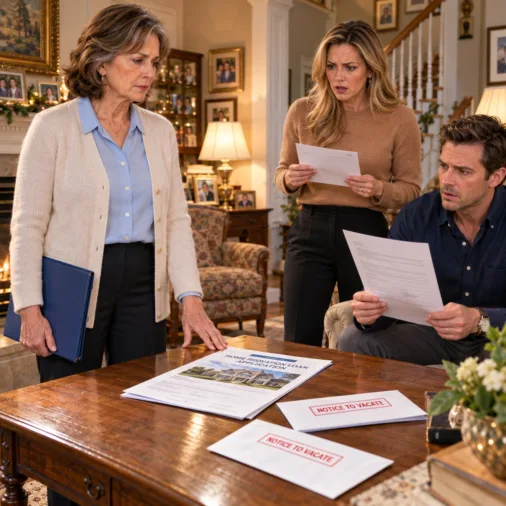
The following evening, I walked into my living room carrying a blue folder and two stamped envelopes.
Ashley was on the sofa with her laptop.
David sat in Tom’s old recliner.
I placed the envelopes on the coffee table.
“One for each of you.”
David looked at me.
“What is this?”
“Open them.”
He did.
His hands started shaking before he finished the first page.
Ashley tore hers open.
She read the heading.
Then she went white.
“What is this?”
“My written notice ending your permission to occupy my property.”
She stared at me.
David whispered, “Mom.”
“I am following the agreement you signed when you moved in, and Robert has made sure we follow the proper legal process.”
Ashley shot to her feet.
“You can’t throw us out. We’re family.”
I looked directly at her.
“You were prepared to throw me out.”
“That is different.”
“How?”
Her face flushed.
“We’re young. We’re trying to build a life. You’re sixty-three years old. You don’t need all this space.”
David closed his eyes.
“Ashley.”
“No. I’m tired of everyone pretending this isn’t ridiculous. One person in a four-bedroom house while we struggle to buy something half this size?”
I reached for the blue folder.
“You seem very concerned about what is fair.”
“I am.”
“Good.”
I removed the second document.
The one she had laughed at three years earlier.
The one she had signed without believing it would ever matter.
I placed it beside her notice.
“Then you should remember this.”
Ashley looked down.
Her anger disappeared.
David leaned forward.
And the moment he saw his signature at the bottom of the page, he whispered one word.
“Oh.”