MY DAUGHTER-IN-LAW TOLD ME TO RENT A ROOM AND LEAVE MY OWN HOME—THEN I PUT ONE BANK DOCUMENT BESIDE HER EVICTION NOTICE AND HER FACE WENT WHITE
Chapter 1 1/7
Get Out of My House
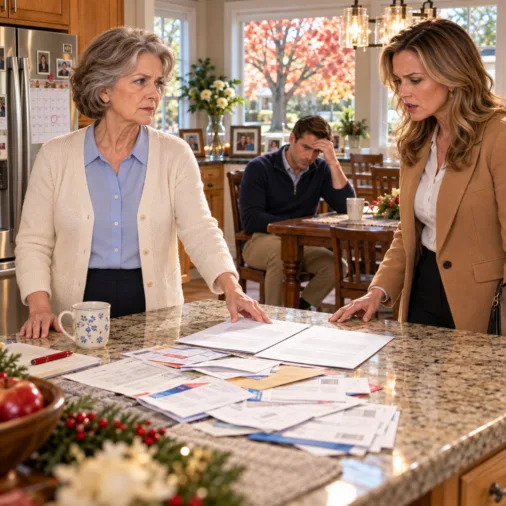
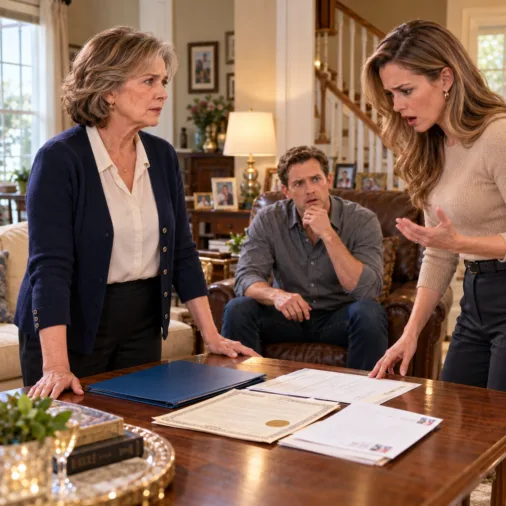
Three days before Christmas, I opened the front door of the house I had owned for thirty-eight years, and my daughter-in-law screamed, “Get out of my house!”
I was seventy-two years old, tired from a six-hour drive, and still holding the handle of my suitcase. For one absurd second, I actually looked over my shoulder to make sure I had not walked into the wrong home. Then I saw the familiar brass number beside the door, the little scratch George had made when he installed the deadbolt twenty years earlier, and the narrow crack in the tile near the entry table. I had not made a mistake. I was standing in my own house.
Jessica was ten feet away from me, barefoot on my living room rug, wearing a white sweater I had never seen before. Her face was tight with anger, but underneath the anger there was something even stranger: surprise. She looked like I had interrupted something she had expected to continue without me.
Behind her stood my son, Matthew.
He was forty-six years old, six feet tall, and suddenly looked about twelve. His face had gone pale. He opened his mouth, closed it, and glanced toward Jessica before looking back at me.
That glance frightened me more than her words.
My only child had just heard his wife call my house hers, and he had not immediately corrected her.
“Excuse me?” I asked.
Jessica folded her arms. “I said you can’t just walk in like this.”
My hand was still on the suitcase. “Walk in like what?”
“Without telling us.”
I stared at her.
Two weeks earlier, I had driven to my younger sister Louise’s house outside Cincinnati after she slipped on ice and broke her wrist. She could manage most things, but cooking, laundry, driving, and even fastening buttons had become difficult. I packed one suitcase, told Matthew I would be gone about fourteen days, put my mail on hold, locked the back door, and left my own house exactly as I had lived in it for nearly four decades.
Now Jessica was telling me I needed permission to enter.
“I told Matthew yesterday that I was coming home today,” I said.
Jessica turned sharply toward him. “You said maybe.”
Matthew rubbed a hand over his face. “Mom, we were going to call you.”
“That would have been useful,” I said. “Before your wife told me to get out of my own house.”
Jessica made an impatient sound. “Nobody is trying to fight with you. You just startled me.”
“You screamed at me.”
“Because you walked in.”
“With my key.”
She looked down at the key still in my hand as if it were new information.
That was when I noticed the porch lights.
George and I had always decorated our red-brick house for Christmas in a way that would never have impressed a magazine editor. He liked colored lights, especially the old-fashioned oversized bulbs. I liked wreaths with too many ribbons. Every December we argued playfully about whether the lights should blink. He always won because he was the one willing to climb the ladder.
After he died, I stopped putting lights along the roofline, but I still wrapped the porch rail in red and green. I had done it before I left for Louise’s.
Now every colored strand was gone.
Perfect white lights framed the windows. White lights wrapped the porch columns. Even the little ceramic Santa that had sat beside my front steps since Matthew was in elementary school had disappeared.
I looked past Jessica toward the living room.
My Christmas tree was still there, but it was not my tree anymore.
The tree had been covered in silver ribbon, white glass balls, and identical frosted ornaments. It looked expensive and elegant and completely unfamiliar. Gone were the paper angels Matthew had made in first grade, my mother’s glass bell, the wooden train George bought during our first trip to Chicago, Louise’s knitted stocking, and the ridiculous felt reindeer with one crooked eye that Matthew had insisted on hanging front and center every year until he went to college.
Most painful of all, George’s star was missing.
He had made that star during our first Christmas in the house. It was cut from thin pieces of pine, slightly uneven, and painted gold with a brush that left visible streaks. One point was shorter than the others because George measured wrong and refused to fix it.
“It has character,” he used to say.
For thirty-seven Christmases, it had been at the top of our tree.
“Where are my decorations?” I asked.
Jessica followed my gaze. “I packed them.”
“You packed them.”
“There was so much clutter.”
Something in my chest tightened.
Matthew stepped forward. “Mom, they’re safe.”
“Where?”
“In the garage,” Jessica said. “I think.”
“You think?”
She rolled her eyes. “We boxed everything carefully.”
I turned toward the hallway before I answered, because I could feel the beginning of anger and I did not want anger to make decisions for me.
Then I stopped.
George’s jacket was gone.
It had been a plain brown canvas jacket with a corduroy collar. Nothing special to anyone else. He wore it every fall for almost twenty years, and when he died four years earlier, I washed it once, hung it on the hallway hook, and never moved it again.
I knew that probably sounded foolish. I knew cloth was not a person. But some mornings, especially during the first year after I lost him, seeing that jacket as I passed through the hallway made the house feel less empty.
Now Matthew’s winter coat hung there instead.
Jessica’s bright pink coat occupied the hook beside it.
Shopping bags, shoes, cardboard boxes, and a folded stroller that did not belong to anyone in our family crowded the wall beneath them. I later learned the stroller was a Christmas gift for Jessica’s niece, but in that moment it looked like one more piece of somebody else’s life spreading into mine.
“Where is George’s jacket?”
Matthew looked at the empty hook.
Jessica answered. “Packed.”
“Where?”
“Probably the garage with the other things.”
Probably.
I put down my suitcase.
For the first time since entering, I looked carefully around the room instead of reacting one piece at a time.
There were boxes stacked behind the sofa.
A television bigger than mine sat on a temporary stand near the fireplace.
Two framed photographs of Jessica’s family had replaced the landscape prints above the sideboard.
A coffee machine I had never seen sat on the kitchen counter.
There were new bar stools at the island.
A set of men’s shoes I recognized as Matthew’s lined the wall.
And beneath the dining room window were three large plastic bins labeled WINTER, OFFICE, and MASTER.
“What is all this?” I asked.
Matthew took a breath. “Mom—”
Jessica answered first.
“We moved.”
The room became strangely quiet.
Their lease had ended the previous week. I knew that. Matthew had mentioned that their apartment complex was raising rents, but he had never told me they planned to leave. He had said they were looking at options.
I had assumed “options” meant another apartment.
“You moved where?” I asked.
Jessica looked around as if the answer were obvious. “Here.”
“Here.”
“It makes no sense for us to keep paying rent when there’s a perfectly good house sitting here.”
I stared at her. “Sitting here?”
“You were gone.”
“I was caring for my sister.”
“I know.”
“For fourteen days.”
“I know how long you were gone.”
“Then why are you talking as though I abandoned the property?”
Jessica’s lips tightened. “That isn’t what I said.”
“It is exactly what you implied.”
Matthew stepped between us slightly, not enough to block either of us, but enough to show that he expected trouble. “Mom, please. We were going to explain everything.”
“When?”
“When you got back.”
“I am back.”
He looked away.
That was when I noticed the upstairs hallway light.
I did not ask permission. I picked up my suitcase and walked toward the stairs.
“Ellie,” Jessica said behind me.
She almost never called me by my first name. She usually called me “Matthew’s mom” when speaking to other people and “you” when speaking to me.
I kept walking.
At the top of the stairs, I turned toward my bedroom.
The door was open.
Jessica’s dresses filled nearly half my closet.
Her perfume bottles stood across my dresser. A jewelry box rested beside the framed photograph of George and me from our thirtieth anniversary. A pair of high-heeled boots sat under the window. A phone charger had been plugged into George’s side of the bed.
Worst of all, piles of clothing lay across the blue quilt George had given me during his final Christmas.
He had been weak by then. Cancer had taken most of his appetite and nearly all his strength. He ordered the quilt online because he could not go shopping, then apologized because he had not wrapped it.
“I wanted you to have something warm after I’m gone,” he had said.
I had slept under it every night since.
“Why are your clothes in my room?” I asked.
Jessica came up behind me.
“Because this is our room now.”
I did not turn around right away.
I looked at the dresser, the bed, the closet, and the photograph of George.
Then I looked at Matthew, who had followed us upstairs.
“Did you tell her this house would eventually be yours?”
His face changed.
That was the first moment I understood this was bigger than convenience.
For years, I had assumed my only child would inherit most of what I owned. George and I talked about it when Matthew was young. After George died, I updated my estate documents and kept Matthew as a beneficiary. I never made a grand announcement about it, but he knew the general plan.
I had thought of inheritance as something that came after a life was finished.
Jessica seemed to think it was a reservation.
Matthew swallowed. “Someday.”
Jessica almost smiled. “Exactly.”
I turned to her. “This house becomes Matthew’s after I die.”
Her smile disappeared.
“Well, yes.”
“So until then?”
Silence.
Matthew finally said, “It’s yours.”
Jessica added, “Legally.”
That one word told me more than the previous ten minutes.
Legally.
Not emotionally. Not morally. Not practically.
Legally.
As if my ownership were a technical delay in the transfer of something they had already started calling theirs.
I set my suitcase beside the bed.
“You have forty-eight hours.”
Jessica blinked. “For what?”
“To remove every box, coat, dress, shoe, appliance, photograph, piece of furniture, and personal item you brought into this house.”
Her mouth opened.
Matthew whispered, “Mom.”
“Forty-eight hours.”
Jessica laughed.
It was not a nervous laugh. It was sharp and disbelieving.
“You’re going to throw your own son out three days before Christmas?”
“No,” I said. “I am telling two adults who moved into my home without permission to move out.”
“And if we don’t?”
“I’m not calling the police on my son three days before Christmas.”
Her expression relaxed a little.
Then I continued.
“I’m calling my attorney. I’m changing every security code connected to this house. And I’m reviewing my estate plan.”
Matthew reacted before Jessica did.
His shoulders stiffened.
His face drained.
He looked at me as if I had announced an illness.
Reviewing my estate plan.
Those four words frightened him more than losing the bedroom.
That frightened me.
Jessica noticed his reaction too. Her eyes moved between us.
“This is ridiculous,” she said. “You can sleep in the spare room until Christmas. There’s no point moving everything around for three days.”
I looked at the woman standing in my bedroom, beside my husband’s photograph, telling me where I could sleep in my own house.
Something inside me became perfectly calm.
If Matthew had called me and said, “Mom, we’re struggling. Our lease is ending. Could we stay with you for three months while we save for a new place?” I probably would have said yes before he finished the sentence.
He knew that.
I had helped him with college tuition. I had covered part of his wedding. George and I had loaned him money for his first car. When he lost his job at thirty-one, he lived with us for six months and never paid rent.
He knew I would help him.
“So why didn’t you ask me?” I said.
Jessica answered immediately. “Because you would have complicated things.”
I ignored her and looked at my son.
“Why didn’t you ask me?”
Matthew’s jaw tightened.
“We didn’t know how you’d react.”
I felt those words in a place I had not expected.
Not because they were cruel.
Because they were cowardly.
“So you decided I didn’t get to react at all.”
He looked away.
That hurt more than Jessica’s insults.
Four years earlier, during George’s final week, he had held my hand in the hospital and said something that became both a promise and an accusation.
“Ellie,” he whispered, “don’t get smaller after I’m gone.”
At the time, I thought he meant grief.
I thought he was telling me to keep going to book club, keep driving, keep traveling, keep laughing too loudly at Louise’s terrible jokes.
I promised him.
Then I spent four years breaking that promise in ways I did not notice.
I accepted canceled Sunday lunches.
I stopped asking Matthew to help with repairs because Jessica said he was too busy.
I let them choose every holiday schedule.
I listened when they called my old furniture “clutter” and my routines “cute.”
I apologized for calling after eight.
I learned to say, “Whatever works for you,” until I barely remembered what worked for me.
Standing in my bedroom, I finally understood that shrinking had not protected my relationship with my son.
It had only taught him how much space I was willing to surrender.
“You have forty-eight hours,” I repeated.
That night, nobody left.
At 2:14 in the morning, unable to sleep, I walked into George’s old study and unlocked the fireproof box beneath his desk.
I spread the deed, mortgage discharge, insurance papers, my will, trust documents, and power-of-attorney forms beneath the yellow lamp he had used for years.
The house was mine.
My name was on the deed.
The mortgage had been paid off eight years earlier.
Matthew was a future beneficiary.
Nothing in those papers gave him a right to my bedroom, my keys, my closet, or one square inch of my house while I was alive.
But as I stared at the documents, I remembered the fear on his face when I said I would review my estate plan.
And a new question entered my mind.
If my son had already started living as though my house belonged to him someday, what else had he already begun treating as his?
By sunrise, the house was no longer the only thing I was afraid of losing.