My Husband Threw His Wedding Ring at My Feet and Called Me a Leech—27 Minutes Later, His Chairman Walked Straight to Me
Chapter 1 1/7
The Ring on the Marble
My Husband Threw His Wedding Ring at My Feet and Called Me a Leech—27 Minutes Later, His Chairman Walked Straight to Me
The wedding ring hit the marble floor before I understood that my marriage had ended in front of four hundred people.
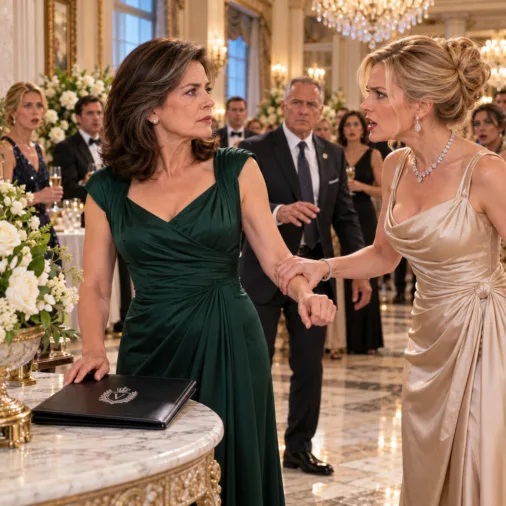
It bounced once under the white lights of the ballroom, spun in a bright little circle, and stopped beside the hem of my black silk dress. Around me, the annual Vance Global leadership banquet went so quiet that I could hear the orchestra pianist lift his hands from the keys. My husband, Caldwell Vance, stood ten feet away with his jaw tight, his mother glaring over his shoulder, and Sloan Mercer pressed close enough to his side that nobody in the room needed an explanation for what she was to him.
“Security,” Caldwell said. “Get this woman out.”
This woman.
Not his wife of ten years. Not the person who had sat beside him through late-night strategy sessions when Vance Global had barely been able to make payroll. Not the person whose family capital had kept the company alive before most of the people in that ballroom had ever heard Caldwell’s name. Not the woman whose signature sat behind the holding company that controlled the votes he had spent years pretending belonged to him.
This woman.
I looked down at the ring, then at the dark red stain spreading across my dress.
Thirty seconds earlier Sloan had been standing beside me with a glass of cabernet and a smile that was too pleased to be accidental. She had leaned close enough for me to smell her perfume and said, “You must feel strange at events like this.”
I had turned toward her. “Events like what?”
“Events where everybody knows who actually built the company.”
Then the wine had struck my chest.
The glass tilted from her hand, red liquid splashed across my dress, and before I could even lift my arms Sloan stumbled backward with a gasp that carried across the nearest tables.
“She attacked me!”
I had not touched her.
Caldwell had pushed through the crowd almost instantly. He had not asked whether I was hurt. He had not looked at the wine dripping from my sleeve. He had not asked the people standing three feet away what they had seen.
He went straight to Sloan.
“Saraphina, what the hell is wrong with you?”
I remember thinking that his anger looked rehearsed. Not because the scene had been planned, but because he had been angry at me for months whenever my presence complicated the version of his life he preferred to show the world.
“Sloan is my guest,” he snapped. “She is one of our most important strategic partners. You embarrass me by showing up like this, and now you attack her?”
“A strategic partner?” I asked. “Is that what you’re calling your mistress now?”
The words landed harder than the wine.
Sloan’s face tightened. Caldwell’s mother, Evelyn, moved toward me so quickly that the diamonds at her throat shook.
“You useless leech,” she hissed. “My son earns millions while you contribute nothing. You should be grateful he lets you stand beside him. Get on your knees and apologize.”
A few people looked away.
A few stared openly.
Most did what powerful people often do when cruelty becomes public. They waited to see which side would be safest to stand on.
Caldwell’s expression changed when I did not react the way he expected. He wanted tears. He wanted a scene. He wanted me to defend myself badly enough that he could call me unstable and rescue Sloan from the mess she had created.
Instead, I wiped a drop of wine from my wrist with a cocktail napkin.
“What exactly would you like me to apologize for?” I asked.
“For humiliating me,” he said.
That answer told me everything.
Not for hurting Sloan. Not for causing a disruption. Not for making a false accusation.
For humiliating him.
Ten years of marriage narrowed into one sentence.
Caldwell had always cared about how a room reflected him. At first, I had mistaken that hunger for ambition. Later, I understood that ambition had curdled into entitlement. The company’s success did not make him grateful. It made him certain that success proved every story he told about himself.
He reached for his wedding ring.
For one strange second, I thought he was going to twist it the way he sometimes did when he was nervous.
Instead, he pulled it off.
“If you’re going to accuse me in front of my board,” he said, “then maybe you don’t belong in my life or my company.”
Then he threw it.
That was the sound I remember most clearly.
Not Sloan’s gasp.
Not Evelyn’s insult.
Not the quiet shock moving through the ballroom.
The ring hitting the floor.
I had spent ten years protecting Caldwell’s dignity from the truth.
I had let magazines describe me as “the private wife” because I did not care about photographs. I had let business reporters assume his family had funded the early expansion because correcting them would have exposed financial arrangements my late father had deliberately kept private. I had allowed Evelyn to tell people I had “married up” because I believed family arguments did not belong in public. I had even let Caldwell take the public credit for decisions that required my approval because I thought a strong marriage did not need a scoreboard.
That ring on the marble showed me what all that silence had purchased.
Contempt.
“You really think I’m nobody?” I asked.
Caldwell laughed.
It was not a nervous laugh. It was the laugh of a man who believed the room belonged to him.
“Tonight is not the night for another one of your little dignity speeches, Saraphina.”
I reached into my evening bag and took out my phone.
Sloan folded her arms.
Evelyn actually smiled.
I tapped one name.
Thaddius answered before the second ring.
“Yes, ma’am?”
My voice was calm. I did not need to raise it.
“Execute the emergency board resolution. Effective immediately, remove Caldwell Vance as chief executive officer and freeze his corporate financial access.”
The nearest tables went still.
Caldwell’s smile weakened but did not disappear.
I continued.
“Send the security team to the Greenwich estate. Recover all three company vehicles tonight. Suspend executive residence privileges pending the board’s written confirmation.”
There was a half-second of silence on the line.
Then Thaddius said, “Yes, ma’am. The team is already downstairs.”
I ended the call.
For three seconds, nobody moved.
Then Evelyn burst out laughing.
It was loud, delighted, almost relieved.
“Oh, please,” she said. “You expect us to believe that?”
Caldwell’s smile came back.
“You hired someone to pretend you’re important?”
A few nervous laughs traveled through the room. Sloan slipped her arm through Caldwell’s and leaned into him as if she had just survived an attack.
I looked at the three of them and felt something inside me become very still.
They truly did not understand.
Caldwell had spent years presenting Vance Global as his empire. He had told interviewers that he had “bet everything” on the company. He had stood on conference stages beneath his own photograph and spoken about ownership as if determination had created shares out of thin air.
But the controlling shares had never belonged to him.
They belonged to Aurelia Holdings, the private company my father had created with our family capital before Caldwell and I married.
And I controlled Aurelia Holdings.
Not ceremonially.
Not through some forgotten trust I had never read.
I controlled the voting shares, the board appointment rights, the executive residence company, and the emergency governance provisions Caldwell himself had signed years earlier when he was still humble enough to read every line twice.
I bent down, picked up his wedding ring, and placed it on the nearest champagne table.
“Enjoy the next thirty minutes,” I said.
Caldwell laughed behind me as I walked away.
I did not leave the ballroom.
That would have looked like retreat, and I was done retreating.
I crossed to a small private lounge near the west corridor, asked an event manager for club soda and a towel, and locked the door long enough to clean the wine from my hands. The stain on the dress remained. I decided to leave it.
For years I had hidden every mark our marriage left on me.
That night, I let one show.
My hands were steady until I looked at myself in the mirror.
Then they began to shake.
Not because I doubted the resolution. Thaddius would not have told me the team was downstairs unless the chairman had already confirmed the required directors were present or reachable. The documents were clean. The authority was real.
I shook because I had loved Caldwell.
That was the humiliating part nobody in the ballroom could see.
I had loved him when he wore cheap suits and drove a used sedan with a passenger window that would not close properly. I had loved him when he came home at two in the morning with spreadsheets folded in his pocket. I had loved him when he told me that if Vance Global ever succeeded, he wanted to build something worthy of the people who had trusted him.
Somewhere along the way, he had stopped asking whether he was worthy of trust.
A knock sounded.
“Saraphina?”
It was Thaddius.
I opened the door.
He was sixty-two, silver-haired, precise, and incapable of unnecessary drama. My father had hired him decades earlier as outside counsel, but over time he had become the person who understood the architecture of our family companies better than anyone alive except me.
He looked at the wine stain.
His jaw tightened.
“Are you all right?”
“No,” I said. “But I will be.”
He handed me a slim folder.
“Chairman Hale has the signed resolution. Four directors approved emergency action. The remaining independent directors have been notified. Corporate access is frozen. Vehicle recovery is underway. The residence notice has been issued.”
“And Caldwell?”
“Still telling people you made the phone call for attention.”
I almost smiled.
“How much time?”
Thaddius glanced at his watch.
“About twelve minutes until Martin reaches the ballroom. He was in the hotel conference wing with the audit committee.”
I looked at him sharply.
“Caldwell told the guests Martin had left.”
“He wanted the room to believe the board evening was over.”
Of course he did.
“Does Martin know about Sloan?”
“He knows enough to require a conflict review. He does not need the details of your marriage to act on governance.”
That mattered to me.
I did not want Caldwell removed because he had embarrassed me. I wanted him removed because the person who had humiliated me was the same person who had spent months ignoring boundaries between his private desires and the company he had been entrusted to lead.
There was a difference between revenge and accountability.
I needed that difference to remain clear, even to myself.
“Then we do this by the documents,” I said. “No speeches about the affair unless he forces it into the discussion.”
Thaddius nodded.
“That is exactly what your father would have said.”
The mention of my father hurt more than I expected.
“He would have told me I waited too long.”
“He might have.”
Thaddius paused.
“He also would have understood why.”
I straightened my shoulders.
“Let’s go back.”
When I reentered the ballroom, the music had started again.
Not fully. The musicians were playing softly because everyone was still watching Caldwell.
He stood near the center of the room with Sloan and Evelyn, surrounded by executives who were pretending to make conversation. He saw me and shook his head as if I were an embarrassing child refusing to go home.
Then the ballroom doors opened.
Three corporate security officers entered first.
Behind them came Martin Hale, chairman of the Vance Global board.
Caldwell had spent the entire evening introducing Martin as his chairman.
The phrase had always bothered me.
My chairman.
My board.
My company.
That night, Martin did not look at Caldwell first.
He looked across the ballroom, found me, and walked straight toward me.
The room went quiet again.
Evelyn slowly lowered her champagne glass.
Sloan removed her arm from Caldwell’s.
And for the first time that evening, my husband looked afraid.
Martin stopped in front of me.
“Ms. Vale,” he said formally, using the family name I had kept on every controlling document even after marriage. “The board has acted on your notice.”
Caldwell took one step forward.
“What notice?”
Martin did not turn.
He held out the folder.
I took it.
Only then did the chairman face Caldwell.
“The notice you should have remembered you signed the day you became CEO.”