My Husband Threw His Wedding Ring at My Feet and Called Me a Leech—27 Minutes Later, His Chairman Walked Straight to Me
Chapter 3 3/7
The Twenty-Seventh Minute
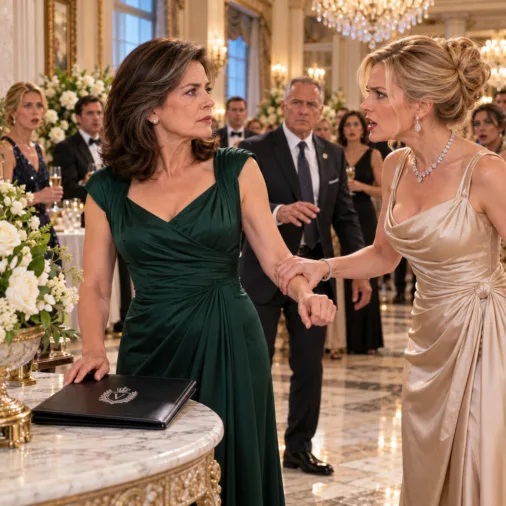
The ballroom did not erupt.
That surprised me.
I had imagined shouting, accusations, maybe even the kind of dramatic scene people retell for years. Instead, the room went strangely disciplined. Senior executives lowered their voices. Directors moved toward Martin. Security stood far enough away not to provoke Caldwell but close enough to make the new balance of power obvious.
Only Evelyn refused to understand.
“This is a family matter,” she said sharply. “Martin, tell her to stop this.”
Martin looked at her with professional patience.
“Mrs. Vance, this is a corporate governance matter.”
“My son is the corporation.”
“No,” I said. “That is the problem.”
Evelyn spun toward me.
“You ungrateful—”
“Don’t.”
I had never interrupted her that way before.
The word was quiet.
It stopped her.
For years Evelyn had mistaken my restraint for weakness because it was convenient. She had called me cold when I refused to compete with her for Caldwell’s attention, lazy when I declined to explain my work, lucky when she stood inside a house funded by my family and praised her son for providing it.
I had swallowed every insult because answering felt petty.
Now I understood that refusing to answer had not created peace.
It had trained her to believe there would never be a boundary.
“You will not speak to me that way again,” I said.
Evelyn blinked.
“Excuse me?”
“You heard me.”
Caldwell stepped between us.
“This is exactly why I didn’t want you here tonight. You come in angry, you attack Sloan, you threaten my mother, and now you’re abusing some technical clause because you can’t handle being jealous.”
The old version of me would have started explaining.
I would have told him I had not touched Sloan.
I would have described the wine.
I would have defended my tone.
I would have tried to persuade a man who already knew the truth.
Instead, I turned to the event manager standing near the wall.
“Was the west ballroom covered by venue security cameras?”
Caldwell froze.
The manager hesitated. “Yes, ma’am. The public areas are.”
Sloan looked at him.
Then at me.
I did not need the recording to know what had happened. The people closest to us had seen enough. But the question changed the room.
Sloan spoke first.
“It was chaotic. Maybe I misunderstood what happened.”
That was fast.
Caldwell looked at her.
“You said she attacked you.”
“I said I felt her move toward me.”
“You said she attacked you.”
Sloan’s face tightened. “Caldwell, I had wine everywhere and people were pushing.”
The wine was on me.
Not her.
Three people nearby noticed at once.
A woman from investor relations looked down at my dress, then at Sloan’s untouched ivory suit.
That small visual truth did more than anything I could have said.
Caldwell saw it too.
He lowered his voice.
“Sloan.”
She pulled her arm away from him.
“I am not going to stand here and be blamed for your family problem.”
There it was.
The first crack.
Not because she suddenly discovered morals.
Because power had moved.
Twenty-seven minutes earlier, attaching herself to Caldwell made her safer.
Now distance did.
I felt no satisfaction from watching it.
Only clarity.
Martin asked Caldwell to surrender his executive badge.
“This is ridiculous.”
“Your access is suspended,” Martin said. “The badge is company property.”
Caldwell looked toward security.
For a moment I saw the argument forming in him. He wanted to refuse because refusal had always forced other people to negotiate.
Then he noticed the room.
Nobody was negotiating.
Slowly, he unclipped the badge from inside his tuxedo jacket.
He held it out to Martin.
Martin nodded toward the head of security instead.
That tiny redirection hurt Caldwell more than a speech would have.
He was no longer dealing with the chairman as an equal.
He was returning property.
The security officer accepted the badge.
“Your phone remains personal,” Martin said, “but corporate email and financial systems are locked. You will receive transition instructions tonight.”
“My files—”
“Preserved.”
“My office—”
“Restricted pending tomorrow’s meeting.”
“My car is outside.”
“One of the three vehicles assigned through the executive fleet,” I said.
He turned.
“You’re actually taking my car?”
“It is not your car.”
He laughed once, but there was no humor in it.
“Listen to yourself.”
I almost repeated his earlier words back to him.
Instead, I said, “I finally am.”
Evelyn’s face went white.
“What about the house?”
Caldwell looked at her, then back at me.
There was a flash of fear I had not expected.
The house mattered differently to each of them.
To Caldwell, it was proof.
To Evelyn, it was victory.
She had spent years inviting people into those rooms and telling them how far her son had risen. She loved the long driveway, the stone facade, the dining room large enough to seat twenty-four, the view across the back lawn.
She had never once asked why every property document used an Aurelia subsidiary name.
“The Greenwich estate remains owned by Vale Residential Holdings,” Thaddius said from behind me. “Executive residence privileges have been suspended. Personal property can be collected under a reasonable schedule.”
Evelyn stared at him.
“You can’t throw us into the street.”
“No one said that,” I replied. “You have your own apartment in Manhattan. Caldwell has personal property and resources. You are not homeless. You are simply no longer entitled to use my family’s property as if it were yours.”
“My family’s property?” Caldwell repeated.
“Yes.”
“You lived there with me for eight years.”
“I know. That did not transfer the deed.”
He rubbed one hand over his face.
For the first time, he looked less like an angry CEO and more like the man I had married—confused, overwhelmed, desperately searching for the sentence that would put the old world back together.
“Saraphina, can we talk privately?”
The request hurt.
Not because I wanted to say yes.
Because there had been a time when I had begged him for exactly that.
Talk to me.
Come home.
Tell me what is happening.
Tell me if you still want this marriage.
Every time, he had been too busy, too tired, too insulted by the question.
Now the room no longer belonged to him, and suddenly privacy mattered.
I looked at Martin.
“Is there anything else you need from me tonight?”
“Only confirmation that you will attend the board meeting at nine.”
“I will.”
Then I faced Caldwell.
“We can speak in the east lounge for ten minutes.”
Evelyn started to follow.
“No,” Caldwell said.
She looked wounded.
“Sloan?” he asked.
Sloan was already three steps away.
“I need to call my legal team,” she said.
Caldwell stared at her.
“Your legal team?”
“Our firm has a contract under review. I’m not discussing anything personal until I understand my obligations.”
Her language had changed completely.
Strategic partner.
Contract.
Obligations.
The vocabulary of distance.
Caldwell’s face hardened.
“Fine.”
He followed me out of the ballroom.
The east lounge was smaller than the one where I had cleaned my dress. Dark wood, two leather chairs, a low table, no windows. I remained standing.
Caldwell closed the door.
“What do you want?”
I almost laughed.
“You asked to talk.”
“No. I mean what do you want from me? Money? The company? A public apology? Sloan gone?”
“You still think this is a negotiation.”
“Everything is a negotiation.”
“That may be the saddest thing you’ve ever said to me.”
He stepped closer.
“Don’t do that.”
“Do what?”
“Talk to me like I’m some stranger.”
I looked at him.
The man in front of me had the same gray eyes I had trusted at twenty-nine. The same small scar near his chin from a bicycle accident he used to joke about. The same habit of pressing his tongue against the inside of his cheek when he was afraid.
He was not a stranger.
That was why it hurt.
“A stranger could not have done this to me,” I said.
His gaze dropped to the wine stain.
“Sloan shouldn’t have thrown the wine.”
The admission was so simple that I went still.
“You knew?”
“I saw enough.”
“You saw enough.”
“Saraphina—”
“You watched her throw wine on me. Then you accused me of attacking her.”
“I was trying to control the room.”
“You were trying to control the story.”
He looked away.
“People were watching.”
“That was more important than whether your wife was telling the truth?”
“That is not fair.”
“No. It isn’t.”
He winced.
I took a breath.
“Is she your mistress?”
Silence.
This time I did not let him escape into anger.
“Caldwell.”
He sat down.
The answer came quietly.
“Yes.”
The word did not break me.
I had already broken months earlier, alone in the hallway outside our library.
But hearing him say it ended the last argument I had been having with myself.
“How long?”
“Eight months.”
I closed my eyes.
That meant the Boston trip.
The hotel terrace.
The charity weekend in Palm Beach.
The conference in Chicago where he had told me spouses were not invited.
A map I had refused to draw became visible all at once.
“Did you love her?”
“I don’t know.”
“That is not an answer.”
“She made things easy.”
I looked at him.
“Easy.”
“With you, everything became a test. The board. The holding company. Your father’s rules. The house that never felt like mine.”
I felt anger rise so fast I had to grip the back of a chair.
“You signed those rules before you married me.”
“I signed them when I needed the money.”
There it was.
Not a confession about Sloan.
A confession about how he had rewritten the beginning.
“You told me you respected the structure.”
“I did then.”
“And now?”
“Now I’m fifty-one years old, I run a company worth more than anyone thought possible, and I still have to ask permission from a holding company with your name on it.”
“My name was on it when you accepted the capital.”
“You were supposed to be my wife.”
“I was.”
“No, you were always the person who could pull the floor out from under me.”
I stared at him.
For ten years, I had avoided using my power because I was afraid he would feel exactly that way.
And he had resented me anyway.
“Do you know why I never became chair?” I asked. “Why I never took an operating title? Why I let you stand on every stage alone?”
“Because you didn’t want the work.”
The cruelty of the assumption stunned me more than I wanted to show.
“No. Because you wanted to build. And I loved you enough to give you room.”
He rubbed his forehead.
“I didn’t ask you to disappear.”
“No. You just benefited from it until you forgot I was there.”
We stood in silence.
Then he said, “Reverse the resolution.”
“No.”
His head lifted.
“We can fix the marriage separately.”
“There is no marriage to fix tonight.”
“You can’t mean that.”
“You threw your ring at my feet.”
“I was angry.”
“You ordered security to remove me from my own company’s banquet.”
“You called Sloan my mistress in front of everyone.”
“She is your mistress.”
He stood again.
“You want to destroy everything because I made one mistake?”
“One mistake?”
I felt my voice sharpen for the first time.
“The affair was a choice. Lying was a choice. Using company access to elevate her while refusing conflict review was a choice. Letting your mother humiliate me was a choice. Watching Sloan frame me and joining her accusation was a choice. Throwing your ring was a choice. Which one do you want me to pretend was the accident?”
He had no answer.
I opened the door.
He said my name.
I stopped.
“You think one night erases ten years?” he asked.
I turned.
“No.”
I looked at the ringless hand hanging at his side.
“But one night can finally reveal what the ten years became.”
Then I walked out.
In the corridor, Thaddius was waiting.
“The vehicles are being secured,” he said. “The estate manager has confirmed receipt of the residence notice.”
I nodded.
“And Sloan?”
“Her firm requested immediate clarification of its contract status.”
“Tell them the board will review it tomorrow. No retaliation. No favors.”
Thaddius gave me a small approving look.
“One more thing.”
“What?”
He held out his phone.
A message from the head of security had just arrived.
The first vehicle had been surrendered at the hotel.
The second was at the estate.
The third had been assigned for use by Evelyn.
She was refusing to return the keys.
For the first time that night, I almost laughed.
“Of course she is.”
Thaddius raised an eyebrow.
“What do you want to do?”
I looked back toward the ballroom, where the woman who had ordered me to kneel was still standing beneath chandeliers paid for by a company she believed her son owned.
“Nothing dramatic,” I said. “Tell security to ask once more. If she refuses, deactivate the vehicle access and arrange a car to take her home.”
“No humiliation?”
“No.”
I had been humiliated enough for one family.
“I want the property back,” I said. “I don’t need her dignity with it.”