THEY TOLD ME TO RENT A ROOM AND LEAVE THE HOUSE I’D OWNED FOR THIRTY-SEVEN YEARS. THEN I PUT THEIR OWN SIGNATURES ON THE TABLE.
Chapter 4 4/6
The Paper Trail
On the thirtieth day, David carried his first box out of my house at 8:15 in the morning.
Ashley did not carry anything.
She stood in the driveway with her arms folded while a moving company loaded furniture into a rented storage unit.
They had not found a house.
They had found a two-bedroom apartment across town.
Or rather, David had.
Ashley told him she refused to move into “another temporary box.”
He signed the lease anyway.
That was the first decision I had seen him make without waiting for her approval in years.
The legal process did not end simply because the calendar reached thirty days. Robert had warned me about that from the beginning.
“If they leave voluntarily, wonderful. If not, we use the proper procedure. No changing locks. No moving belongings to the curb. No drama.”
I followed his instructions.
David appeared ready to leave.
Ashley was not.
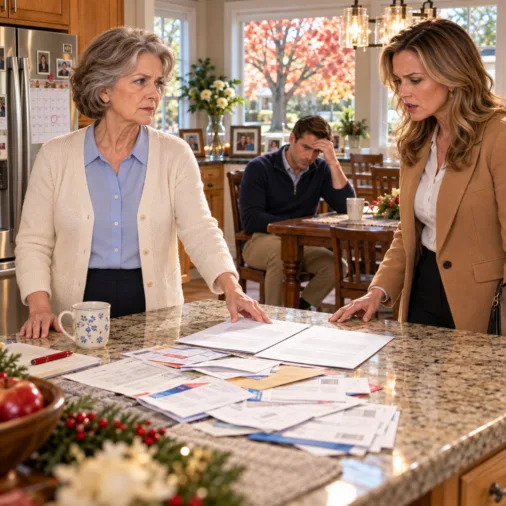
At nine-thirty she walked into the kitchen while the movers were upstairs.
“I want an extension.”
I was wrapping dishes from the guest kitchenette.
“How long?”
“Ninety days.”
“No.”
“Sixty.”
“No.”
“Thirty.”
“You have already had thirty.”
“This is insane.”
I folded another sheet of paper around a mug.
“You have an apartment.”
“I don’t want that apartment.”
“That is between you and David.”
Her face tightened.
“I could stay.”
“You can discuss that with your lawyer and Robert.”
“You really need a lawyer to talk to your own family?”
“No. I need a lawyer because my signature appeared on a financing document I never signed.”
She looked away.
“You keep saying that as if I tried to steal your identity.”
“What would you call using my signature without permission?”
“It was one letter.”
“One is enough.”
“It didn’t even go through.”
“Because the lender called me.”
She stared at me.
I stopped wrapping.
“Ashley, I have spent weeks asking myself whether I somehow created this.”
Her eyebrows pulled together.
“I asked whether I made you feel unwelcome. Whether I held the house over you. Whether I said something that sounded like a promise.”
“You did say it was our home.”
“I said you were welcome to make yourselves at home.”
“Same thing.”
“No.”
My voice stayed calm.
“A home is where you are allowed to belong. Ownership is a legal right. I gave you the first. You decided it meant the second.”
She looked toward the hallway.
“You never liked me.”
“That is not true.”
She laughed.
“I was never good enough for David.”
“You were good enough the day he married you. What changed was how you treated me.”
Her mouth opened.
I continued.
“When you replaced my dining chairs without asking, I said nothing. When you gave away my pantry shelves because you wanted open storage, I told myself you were settling in. When you invited twelve people for New Year’s Eve and told me afterward, I cooked for them.”
Ashley’s eyes flickered.
“I kept choosing peace.”
“You kept score.”
“No. I remember.”
That silenced her.
I set down the mug.
“You are not being asked to leave because you changed curtains.”
She stared at me.
“You are being asked to leave because you looked at a sixty-three-year-old widow and decided her life could be compressed into a rented bedroom because you wanted what she owned.”
Her face hardened again.
“You think you’re some helpless widow? You have almost a million dollars sitting under you.”
There it was.
I almost thanked her for finally saying it plainly.
“The house is not cash until I decide to sell it.”
“You could help your son.”
“I have helped my son.”
“Not like this.”
“No.”
I nodded.
“Not by giving him my home because his wife wants it.”
Her cheeks flushed.
“I was trying to build something.”
“So was I.”
She looked confused.
I gestured around us.
“This.”
For the first time, Ashley had no quick reply.
She left the kitchen.
By sunset, most of their belongings were gone.
David found me in the garage.
“I’m coming back tomorrow for the last boxes.”
“All right.”
He hesitated.
“Ashley may not.”
“All right.”
“Mom.”
I waited.
“I found your old banking box.”
My breath caught.
“Where?”
“In the trunk of her car.”
The garage seemed to shrink.
“What?”
“She said she moved it because she was organizing the office.”
“When?”
“She doesn’t remember.”
“You believe that?”
“No.”
He looked close to tears.
“I put it on your workbench.”
I walked past him.
The cardboard box sat beside Tom’s old tool chest.
I opened it.
Cancelled checks.
Deposit slips.
Old bookkeeping invoices.
Tax records.
I pulled out a packet from eight years earlier.
Several checks displayed the old signature that appeared on the gift letter.
I sat on the stool.
David stood several feet away.
“I’m sorry.”
“Stop saying that.”
He recoiled.
I looked at him.
“Do something with it.”
“What?”
“Your apology.”
I tapped the box.
“Turn it into behavior.”
He nodded slowly.
“I told Northfield I’ll cooperate fully.”
“Good.”
“I told Robert too.”
“Good.”
“I gave him access to my application emails.”
I looked up.
“Why?”
“Because I need to know what I signed, what I ignored, and what was added.”
That was the first thing he had said in weeks that made me believe change might be possible.
The lender’s review took time.
Robert reminded me repeatedly that an investigation was not a verdict.
We did not know whether any criminal charge would result.
We did know the mortgage application was dead.
We knew the lender had records.
We knew I had formally disputed the signature.
And we knew David’s application account contained emails showing Ashley had taken the lead on several uploads.
That was enough for me to stop doubting my own memory.
Two weeks after they moved out, Karen Patel contacted Robert.
Ashley wanted to resolve the property dispute permanently.
We met again.
This time David arrived alone.
Ashley sat beside Karen.
She looked different.
Not physically.
The polish was still there.
Hair perfect.
Coat expensive.
But the certainty had gone out of her.
Karen placed a proposed settlement on the table.
Ashley would disclaim any ownership or equity claim.
She would acknowledge that I had never promised to transfer the house.
She would agree that any future disputes about personal property would be handled through counsel.
In return, I would not seek reimbursement for ordinary occupancy costs during the years they lived with me.
Robert looked at me.
I almost laughed.
“I was never going to charge them three years of back rent.”
Karen nodded.
“Then that provision should be easy.”
“It is.”
There was another section.
The refrigerator.
David actually smiled.
“Mom can keep the refrigerator.”
I looked at him.
“I intended to.”
For one second the room felt almost human again.
Then Robert reached the final issue.
“The lender matter is separate.”
Ashley’s shoulders stiffened.
Karen nodded.
“We understand.”
Ashley finally spoke.
“Are you going to press charges?”
The question was directed at me.
I chose my words carefully.
“I am going to tell the truth whenever I am asked.”
“That isn’t what I asked.”
“It is the only promise I am making.”
She looked down.
Karen placed a hand on the settlement.
“Mrs. Sullivan is not the investigating authority.”
Ashley nodded.
I watched her.
For weeks I had imagined this moment.
I thought I would feel triumphant.
Instead I felt tired.
“Ashley,” I said.
She looked up.
“Why?”
Karen shifted slightly.
Robert said nothing.
Ashley knew what I meant.
Why the room listing?
Why the house?
Why the signature?
Why had eight hundred thousand dollars become worth destroying a family?
At first I thought she would refuse.
Then something in her expression collapsed.
“We were broke.”
David stared at her.
“What?”
She closed her eyes.
“We weren’t broke-broke.”
“Ashley.”
She opened them.
“I had debt.”
“How much?”
Karen looked at her client, but Ashley continued.
“Credit cards. Personal loan.”
David’s voice went flat.
“How much?”
“About forty-seven thousand.”
He leaned back as though struck.
I understood something then.
Not justification.
Context.
Ashley had not simply wanted a bigger kitchen.
She had built an expensive life she could no longer afford.
The vacations.
Furniture deliveries.
Designer bags she claimed were discounted.
Dinners with friends.
All while living rent-free.
David stared at her.
“You told me you had twelve thousand left.”
“I was paying it.”
“With what?”
“I thought once we bought this place—”
“How would buying an eight-hundred-fifty-thousand-dollar house fix forty-seven thousand dollars of debt?”
She looked at me.
“Equity.”
The word hung in the room.
David went pale.
Ashley continued.
“If Margaret gave us the equity gift, we could structure things differently. Later we could refinance.”
Robert’s eyes narrowed.
Karen closed her notebook.
David whispered, “You were going to borrow against Mom’s house.”
“Our house.”
“No.”
His voice was so sharp everyone stopped.
“It was never our house.”
Ashley stared at him.
He pushed his chair back.
“You knew that.”
“I thought—”
“No. You knew.”
He stood.
“And I helped you pretend otherwise.”
For the first time, David looked directly at me without asking me to rescue him from what he had done.
“That part is mine.”
Then he walked out of the room.
Ashley remained frozen.
I looked at her.
Fear can explain greed.
Debt can explain desperation.
Shame can explain why someone keeps lying after the first lie.
But explanation is not permission.
“You should have told him,” I said.
She nodded once.
“You should have told me you were scared.”
Her eyes filled.
I continued.
“I might have helped you find a financial counselor. I might have helped you make a budget. I might even have loaned you money under the right circumstances.”
She looked at me.
“But you didn’t want help.”
My voice softened.
“You wanted control of the asset.”
A tear slipped down her cheek.
She wiped it away angrily.
“I didn’t think it would become this.”
“Things become what we repeatedly choose.”
Ashley signed the settlement.
So did I.
When I left Robert’s office, David was standing beside my car.
“I’m not going back to the apartment tonight,” he said.
I waited.
“I’m staying at a hotel.”
“Why?”
“I need space.”
“From Ashley?”
“From the version of myself that kept saying yes because no was uncomfortable.”
I unlocked my car.
He stepped closer.
“Can I come home?”
The question cut deeper than he knew.
I looked at him for a long time.
“No.”
Pain crossed his face.
I continued before he could speak.
“Not yet.”
He nodded.
That mattered.
The old David would have argued that he was my son.
This David simply said, “Okay.”
I got into the car.
Before I closed the door, he said, “I’ll keep doing the work.”
I looked at him.
“Then do it without knowing whether it earns you what you want.”
He nodded again.
I drove home alone.
That evening, I changed the alarm code.
Not because I hated my son.
Because trust without boundaries was what had brought us here.