My Husband Threw His Wedding Ring at My Feet and Called Me a Leech—27 Minutes Later, His Chairman Walked Straight to Me
Chapter 7 7/7
What the Ring Finally Meant
A year after the banquet, Martin Hale asked whether I would attend the next leadership dinner.
I almost said no.
Then I realized avoidance would give the old night more power than it deserved.
So I went.
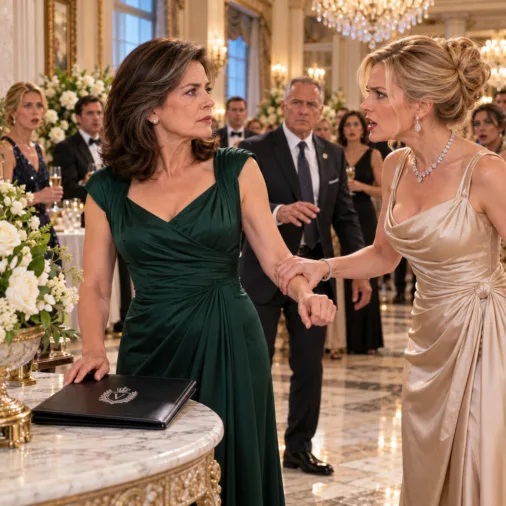
The ballroom was different that year.
Different hotel.
Different stage.
Different CEO.
Still, when I entered in a dark blue dress and heard the low sound of hundreds of conversations, my body remembered the red wine before my mind did.
I stopped near the door.
For one second I saw Sloan’s smile.
Evelyn’s face.
Caldwell’s ring turning on marble.
Then Elena approached me.
“You okay?”
“Yes.”
She looked skeptical.
“I’m getting there.”
“That I believe.”
We walked in together.
No one whispered that I was the CEO’s wife.
No one wondered why I was there.
My name was on the program because of my actual role.
It should not have mattered as much as it did.
But after years of being misnamed, correct naming felt almost physical.
During dinner, Martin gave a short speech about governance, succession, and long-term stewardship. He did not mention the previous year.
Neither did I.
Some lessons become stronger when they stop needing the story attached.
After the meal, I stepped into the corridor for air.
A man was standing near the windows.
Caldwell.
I had known he might attend because he still held a small shareholder position and had been invited as a former CEO. We had not seen each other in seven months.
He looked older.
Not dramatically.
Just honestly.
The kind of older that appears when a person has stopped arranging his face for cameras.
“Saraphina.”
“Caldwell.”
For a moment neither of us knew what to do.
Then he smiled.
“You look well.”
“So do you.”
“How’s Aurelia?”
“Busy.”
“I read about the infrastructure fund.”
“I assumed you would.”
He laughed.
“You still think I read every business article.”
“You used to read the ones about yourself first.”
“That is unfortunately true.”
The ease surprised me.
Not intimacy.
Not romance.
Just the absence of war.
“How is Ohio?” I asked.
“Cold.”
“It’s October.”
“I’m preparing early.”
I smiled.
He looked through the ballroom doors.
“Elena’s doing a good job.”
“Yes.”
“Better than I did in some ways.”
“That is generous.”
“It is also true.”
He put his hands in his pockets.
“I wanted to tell you something.”
I waited.
“I used to think the worst night of my life was the night you removed me.”
“You removed yourself. The board handled the paperwork.”
He laughed.
“Still precise.”
“Still necessary.”
He nodded.
“Fine. The night the board removed me.”
His expression grew serious.
“It wasn’t the worst night. The worst night was about a month later, when I woke up in an apartment I had rented with my own money, drove a car I had bought with my own money, and realized none of that made me feel smaller.”
I did not understand at first.
He continued.
“I had spent years acting like every rule around me was designed to humiliate me. Every reminder that I didn’t own everything felt like someone questioning whether I deserved anything. Then suddenly I had less, and I was still me.”
“That sounds obvious.”
“It should have been.”
He looked at me.
“I wish I had learned it before I made you pay for it.”
That was the apology I had needed.
Not “I’m sorry I got caught.”
Not “I’m sorry the board acted.”
Not even “I’m sorry about Sloan.”
I’m sorry I made you pay for my insecurity.
I felt something loosen inside me.
“I accept that,” I said.
His eyes went bright.
“Thank you.”
We stood quietly.
Then he reached into his jacket.
For one absurd second, my whole body tensed.
He noticed.
“Not a ring,” he said quickly.
I laughed despite myself.
He pulled out a small envelope.
“I found this while moving boxes last year. I didn’t know whether to send it.”
I took it.
Inside was a photograph from Vance Global’s old Stamford office.
Caldwell stood beside a whiteboard covered in numbers. I was sitting on the edge of a desk with my shoes off, holding takeout cartons. My father was in the background arguing with Thaddius.
All of us were laughing.
On the back Caldwell had written a date.
Below it, one sentence.
Before I started pretending I did it alone.
I looked up.
“Keep it,” he said. “I have a copy.”
I slipped the photograph back into the envelope.
“Thank you.”
He glanced toward the ballroom.
“I won’t keep you.”
“Caldwell.”
He turned.
“I’m glad you’re doing better.”
He nodded.
“I’m glad you stopped disappearing.”
Then he walked away.
I stayed by the window for another minute.
The city lights below looked nothing like the marble floor from the year before.
Yet that ring still mattered.
For months, I had thought of it as the symbol of betrayal.
Later, I thought of it as the moment I reclaimed power.
Eventually I understood it meant something more complicated.
The ring hit the floor because Caldwell believed throwing it would reduce me.
Instead, it ended the performance that had reduced both of us.
He had been performing total ownership.
I had been performing total indifference to being erased.
Evelyn had been performing a family mythology in which her son created everything alone.
Sloan had been performing confidence built on proximity to a title.
The banquet stripped all of it away in twenty-seven minutes.
But the real change took much longer.
It took a board meeting.
A moving truck.
A quiet estate.
An office without Caldwell’s name on the door.
A year of learning that boundaries were not cruelty.
A year of learning that forgiveness did not require reunion.
A year of remembering that I had never needed to humiliate anyone in order to stop being humiliated.
I returned to the ballroom.
Elena was speaking with two regional directors. Martin waved me over.
For the rest of the evening, we talked about business.
Actual business.
Hiring.
Expansion.
Margins.
A new employee training program.
Nothing dramatic happened.
Nobody threw wine.
Nobody lost a title.
Nobody ordered security across a room.
And I realized I preferred it that way.
Viral moments make good stories.
Healthy lives are usually quieter.
At the end of the night, I walked past a champagne table near the exit.
A waiter had left a small silver tray there.
For an instant, the shape of it reminded me of the table where I had placed Caldwell’s ring.
I stopped.
The ring itself was no longer in my possession.
My attorney had returned it with Caldwell’s personal effects during the separation. I had not wanted to keep it as a trophy.
I had kept one thing instead.
His six-word note.
I forgot who stood beside me.
It remained in a box at home with our anniversary photograph and the old picture from the Stamford office.
Not because I wanted to remember his failure.
Because I wanted to remember mine too.
I had mistaken silence for grace.
I had mistaken being underestimated for being safe.
I had mistaken love for an obligation to protect someone from every consequence, including the consequences they needed in order to change.
I would not make those mistakes again.
Outside the ballroom, a driver asked whether I wanted the car brought around.
“No,” I said.
The hotel was only three blocks from my apartment in the city, and the night was clear.
I walked.
My heels clicked against the sidewalk.
No security followed.
No board waited.
No family watched.
I was simply a woman walking home under her own name.
For ten years, people had called me a gold digger, a decorative wife, a quiet dependent, a woman lucky to stand beside Caldwell Vance.
I had wasted too much energy believing dignity meant never correcting them.
Now I knew better.
Dignity was not silence.
Power was not volume.
Love was not surrender.
And ownership was not the story someone repeated most confidently in a crowded room.
The truth had been there from the beginning—in the signatures, in the shares, in the house documents, in the board rules, and in every moment I chose to stand beside a man who gradually forgot I was standing there.
The night he threw his ring at my feet, he thought he was ending my place in his world.
Twenty-seven minutes later, the chairman walked toward me.
But that was not the moment I won.
I won when I stopped needing Caldwell, Evelyn, Sloan, the board, or the ballroom to confirm that I had value.
I won when I could tell the truth without revenge.
I won when I could let Caldwell become better somewhere else without needing to be the woman beside him.
And the next morning, when sunlight fell across the old photograph on my kitchen table, I finally understood what my father had been trying to teach me all those years.
If silence protects love, it can be mercy.
If silence protects a lie, it becomes surrender.
I had surrendered long enough.
I would never do it again.