MY DAUGHTER-IN-LAW TOLD ME TO RENT A ROOM AND LEAVE MY OWN HOME—THEN I PUT ONE BANK DOCUMENT BESIDE HER EVICTION NOTICE AND HER FACE WENT WHITE
Chapter 2 2/7
The Papers Under George’s Lamp
I stayed in George’s study until the sky turned gray.
The room still smelled faintly of cedar because he had lined the old desk drawers himself. His reading glasses rested in a shallow wooden tray beside a dried-out fountain pen. I had changed almost nothing in that room after his death, partly because I loved it and partly because I was afraid that if I moved too many things at once, I would erase him by accident.
At five thirty, I made coffee and carried it back to the desk.
Then I started reading.
Not skimming.
Not assuming.
Reading.
The first document was the deed. My name and George’s had once appeared together. After his death, the title had transferred fully to me. The county records attached to my file were clear.
The second was the mortgage release.
Paid in full.
The third was my revocable trust.
I had established it after George died because our attorney, Susan Keene, had explained that it would simplify things if I became ill or died. I was trustee. Matthew was named as successor trustee. He was also the primary beneficiary after my death.
The fourth was my durable power of attorney.
Matthew’s name appeared there too.
That page made me sit back.
Nothing was wrong with the document. I had signed it willingly. At the time, naming my only child had seemed natural. If I had a stroke, an accident, or some other crisis, he could handle bills and financial matters for me.
Four years earlier, I trusted him without needing to think about it.
At six in the morning, I was thinking about it.
I picked up my phone and called Susan’s office, knowing I would get voicemail.
Instead, a sleepy voice answered.
“Keene Legal.”
I almost hung up.
“Susan?”
“Ellie?”
“I’m sorry. I expected the machine.”
She laughed softly. “My office line forwards to my cell during the holidays in case a client has an emergency. Please tell me this is not an emergency involving a hospital.”
“No hospital.”
“Then I’m already relieved.”
I looked toward the closed study door.
“I need to change my estate documents.”
There was a pause.
Not a dramatic pause. A professional one.
“Are you safe?”
“Yes.”
“Is anyone pressuring you?”
“No. The opposite, actually.”
“What happened?”
I told her.
I did not embellish. I did not call Jessica names. I explained that I had been away for two weeks, that Matthew and Jessica had moved into my home without permission, that they had taken over my bedroom, packed my possessions, referred to the house as theirs, and reacted strongly when I mentioned my estate plan.
Susan listened without interrupting.
When I finished, she said, “Ellie, do they have access to your financial accounts?”
“Matthew is emergency contact on some things.”
“That was not my question.”
I looked back at the papers.
“He is successor trustee.”
“Only after you can no longer serve or after your death, depending on the document. That does not give him present authority.”
“I know.”
“Does he have online passwords?”
“No.”
“Keys?”
“To the house, yes.”
“Any signed blank checks?”
“No.”
“Any joint accounts?”
“No.”
“Any bills in his name at your address?”
“I don’t think so.”
The fact that I had to say I don’t think so bothered me.
Susan continued. “I want you to do two things this morning. First, call your bank and confirm exactly who is authorized on every account. Second, do not sign anything anyone puts in front of you until we talk.”
“No one has asked me to sign anything.”
“Good.”
“You sound worried.”
“I sound careful.”
That distinction mattered.
Susan had known George and me for nearly twenty years. She was not the kind of lawyer who manufactured fear to make herself important. If anything, she had spent years telling me not to worry about small things.
“Can I change the trust today?” I asked.
“Yes, although I want to understand what outcome you want. Do you want to disinherit Matthew?”
The question landed heavily.
“No.”
I answered too quickly.
Then I thought about it.
“No,” I repeated. “I don’t want revenge. I want clarity.”
“Good. Clarity is easier to draft than revenge.”
I almost smiled.
“I don’t want him managing my affairs if he has started thinking of them as his future property.”
“That makes sense.”
“And I don’t want the house passing directly to him if that makes him feel entitled to it while I’m alive.”
“Also reasonable.”
Susan told me she could meet me at eleven. Her office was technically closed, but she planned to go in for an hour anyway. She asked me to bring the trust, will, power of attorney, and health-care proxy.
Before hanging up, she said, “Ellie?”
“Yes?”
“Do not let embarrassment talk you out of protecting yourself. Families get into trouble because people are afraid that setting a boundary is the same thing as declaring war.”
I looked at George’s empty chair.
“I think I’ve been afraid of that for four years.”
“Then perhaps today is about more than paperwork.”
After the call, I opened the banking app on my phone.
Everything looked normal.
I called the bank anyway.
The representative verified my identity and reviewed the ownership on each account. My checking, savings, certificate of deposit, and brokerage account were mine alone. Matthew was listed as a payable-on-death beneficiary on two accounts, but he had no current access.
I felt relief.
Then embarrassment.
I had spent the last hour imagining possibilities that had not happened.
But relief did not erase the reason I had become afraid.
I went upstairs at seven.
Matthew was sitting at the kitchen island in sweatpants, staring at a mug of coffee. Jessica was nowhere in sight.
He looked like he had not slept either.
“Mom.”
“Good morning.”
He glanced toward the hallway, then lowered his voice. “Can we talk?”
“We are talking.”
“I mean really talk.”
I poured myself fresh coffee.
“All right.”
He rubbed his hands together. “We messed up.”
It was the first honest sentence he had said since I came home.
I waited.
“Our lease ended Friday,” he said. “The rent increase was worse than I told you. We’ve been trying to save, and we had some expenses this year. Jessica thought it made sense to stay here for a while.”
“Jessica thought.”
“I agreed.”
I nodded. “Thank you.”
“For what?”
“For using the correct verb.”
He looked down.
“We were going to ask you.”
“When?”
“Before you left.”
“You knew Louise was hurt almost three weeks ago. You had time.”
“I know.”
“Then you knew I would be gone.”
He said nothing.
The answer was obvious.
They had not moved in despite my absence.
They had moved in because of it.
“How long did you plan to stay?”
“A few months.”
“Which few?”
He frowned.
“Until spring?”
“That sounds like a guess.”
“It was.”
“Did you give notice anywhere else? Apply for another apartment?”
“No.”
“So there was no actual plan to leave.”
He flinched.
I did not raise my voice.
That was new for me. Not because I usually shouted, but because I usually softened. I usually rescued the other person from discomfort before they had to sit in it.
That morning, I let my son sit in the discomfort he had created.
“Why were you so frightened when I said I would review my estate plan?” I asked.
His head came up.
“I wasn’t frightened.”
“You were.”
“Mom—”
“Do not insult both of us.”
He stared at me.
Then his shoulders sagged.
“Because I knew how this looked.”
“How does it look?”
“Like I’m waiting for you to die.”
The words hurt even though I had already thought them.
I wrapped both hands around my mug.
“Are you?”
“No.”
He answered quickly, and for the first time I believed him.
But believing he did not want my death was not the same thing as trusting his judgment.
“Then why did you let your wife call my bedroom yours?”
“I didn’t know she was going to say that.”
“You did know your clothes were in my closet.”
He looked away.
“Why did you let her pack George’s things?”
“She said we needed space.”
“And what did you say?”
“Nothing.”
There it was again.
Silence.
Matthew’s silence had become an active force in our family. Jessica decided. I adjusted. Matthew said nothing.
It kept the peace for him.
Everyone else paid for it.
“When your father was dying,” I said, “he told me not to get smaller.”
Matthew’s face changed.
He had been in the room that night.
“I remember.”
“I thought grief made me smaller. It didn’t. Fear did.”
“What were you afraid of?”
“Losing you.”
His eyes closed briefly.
“I thought if I asked for too much, expected too much, objected too much, you would stop coming around. So I made myself easy. I told myself that was love.”
“Mom.”
“But easy people are convenient to ignore.”
He looked at me then, really looked at me.
I continued.
“I would have helped you if you had asked.”
“I know.”
“That is what makes this worse.”
Jessica entered the kitchen before he could answer.
She was dressed now, hair pulled back, phone in hand.
“Matthew, the storage place opens at eight.”
I looked at him.
“Storage place?”
Jessica froze.
Matthew looked tired.
“For some of your things,” he said.
“My things?”
Jessica sighed. “The garage is packed. We were going to rent a unit after Christmas.”
I turned toward her.
“You were going to move more of my belongings out of my house?”
“To make room.”
“For you.”
“For all of us.”
“No. For you.”
She set her phone on the counter.
“You are making this personal.”
“It is my bedroom.”
“I mean you are turning a practical problem into a personal attack.”
“Practical for whom?”
She looked at Matthew as though he should intervene.
He did not.
That was the first small change.
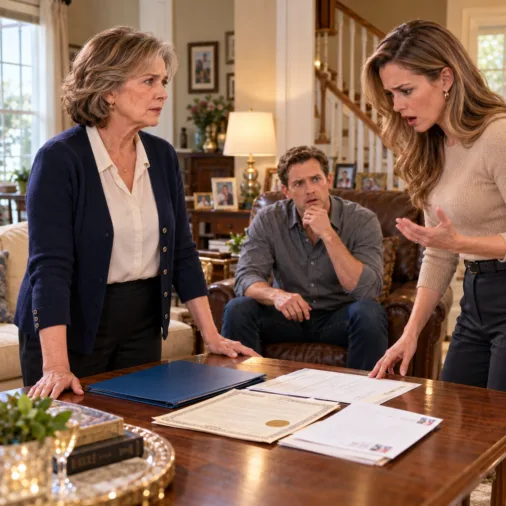
I reached into the folder I had brought from the study and removed a photocopy of the deed.
I placed it on the island between us.
Jessica stared at it.
“I don’t need a legal lecture,” she said.
“Good, because I’m not giving one. I’m giving you a deadline.”
“You cannot expect us to find a place in two days.”
“I expect you to stop acting as though your lack of planning transferred ownership of my home.”
Matthew whispered, “Mom, please.”
I looked at him.
“I will help you find a temporary rental. I will even help with a security deposit if you ask me properly and we put it in writing.”
Jessica’s expression hardened.
“So you’ll give us money but you won’t let us stay in a house that will be Matthew’s anyway.”
Matthew winced.
I did not.
“No,” I said.
She stared at me.
“Why not?”
“Because I am still alive.”
The kitchen went silent.
I picked up my folder.
“I have an appointment at eleven.”
Matthew knew exactly what kind of appointment.
His eyes dropped to the papers.
And for the first time since I came home, I saw something other than fear in his face.
Shame.