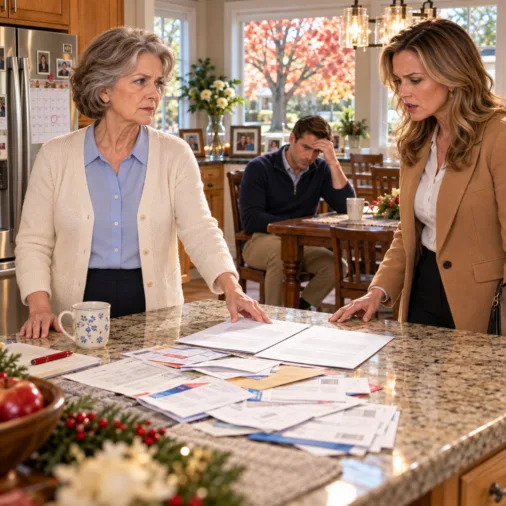
MY DAUGHTER-IN-LAW TOLD ME TO RENT A ROOM AND LEAVE MY OWN HOME—THEN I PUT ONE BANK DOCUMENT BESIDE HER EVICTION NOTICE AND HER FACE WENT WHITE
Chapter 3 3/7
Forty-Eight Hours
Susan’s office occupied the second floor of an old brick building above a pharmacy. George used to joke that it was the only law office in the city where a person could update a will and buy cough drops without moving the car.
At eleven fifteen, I sat across from Susan with a yellow legal pad between us.
She was sixty-three, silver-haired, direct, and incapable of pretending a bad idea was a good one.
She read my trust amendment, then looked over her glasses.
“You still do not want to disinherit him?”
“No.”
“Good. I am asking because anger changes quickly. Documents do not.”
“I am angry, but that isn’t the point.”
“What is the point?”
I thought about Jessica in my bedroom.
Matthew staring at the floor.
George’s missing jacket.
“The point is that I named my son to manage things for me because I trusted him to protect my interests. Yesterday he showed me that when his interests and mine conflict, he may stay quiet.”
Susan nodded.
“That is a precise concern.”
“I don’t want to punish him for a bad week. But I don’t want him to have authority he has not earned.”
We spent the next hour reviewing every document.
The process was less dramatic than people imagine. No one slammed a stamp onto a desk. No one gasped at shocking clauses. Susan asked questions, took notes, explained options, and made me choose what I actually wanted instead of what would hurt the people who hurt me.
I removed Matthew as my primary agent under the financial power of attorney.
I replaced him with Susan temporarily, with Louise as backup once her wrist healed and she agreed. I also changed the successor trustee of my living trust from Matthew to an independent fiduciary Susan recommended.
Matthew remained a beneficiary.
But the house would no longer pass directly to him.
After my death, the trust would sell the property unless I changed the instructions later. The proceeds would become part of the estate and be distributed according to the trust, rather than handing him the keys to the exact house he had started treating as already his.
I also added language making clear that no beneficiary had any present right to occupy, control, manage, or make decisions about trust property while I was alive and competent.
Susan told me the language was not strictly necessary.
I told her I needed to see it anyway.
She understood.
“Do you want to reduce his share?” she asked.
I sat with the question.
“No.”
“Not at all?”
“Not today.”
“Why?”
“Because the money is not the lesson.”
Susan smiled faintly.
“What is?”
“That I am a person before I am somebody’s future inheritance.”
She put down her pen.
“That sentence is clearer than most legal documents.”
When I returned home around one, a rental van sat in the driveway.
For a hopeful moment, I thought Matthew had already begun moving out.
Then I saw Jessica directing two men toward the garage.
My stomach dropped.
“What is happening?” I called.
One of the men stopped.
Jessica turned.
“We’re moving some things into storage.”
“Whose things?”
She did not answer.
I walked into the garage.
Three of my plastic Christmas bins were stacked near the open van. Beside them were two boxes labeled GEORGE, one box of old photo albums, and a wooden chest that had belonged to my mother.
I stepped between the workers and the boxes.
“These do not leave.”
The taller man raised both hands. “Ma’am, we were told these were going to the storage unit.”
“They are not.”
Jessica followed me inside.
“We need the space.”
“You have thirty-six hours left in the house. You do not need any space.”
“You said forty-eight.”
“Yesterday afternoon. Do the math.”
The workers looked at each other.
Jessica lowered her voice. “You are humiliating me.”
That almost made me laugh.
“You invited strangers to remove my family belongings from my garage while I was meeting my attorney.”
“We were organizing.”
“No. You were continuing.”
Matthew appeared at the garage door.
He took in the scene.
“What happened?”
Jessica pointed at me. “Your mother is making the movers stop.”
“They are touching her things,” he said.
Her head snapped toward him.
I looked at my son.
It was a small sentence.
But it was the first time since I returned that he had said something simple and true before checking Jessica’s face.
She noticed too.
“So now you’re taking sides?”
He rubbed the back of his neck. “Jess, they are her things.”
“And our things are all over the house because she gave us two days to disappear.”
“I gave you two days to reverse something you did without permission,” I said.
She glared at me.
I turned to the workers.
“I’m sorry you were brought into this. Please remove only items that belong to Matthew and Jessica. Nothing else.”
They looked at Matthew.
He nodded.
Jessica made a furious sound and walked back into the house.
The taller mover whispered, “Family holiday?”
I almost smiled.
“Apparently.”
For the next four hours, the house became a map of ownership.
That sounds cold, but it was strangely clarifying.
Matthew’s clothes went into boxes.
Jessica’s perfume went into boxes.
Their kitchen appliances were packed.
Their framed photographs came off my walls.
Their television left the living room.
My things came back out of storage.
The crooked wooden star was at the bottom of a bin wrapped in an old towel.
I held it in both hands.
One point was chipped.
Not broken badly, just a little white mark where the gold paint had come away.
I ran my thumb over it.
Matthew stood nearby.
“I’m sorry,” he said.
“For the chip?”
“For all of it.”
I looked at him.
“Do you know what bothered me most?”
He shook his head.
“You packed your father.”
His eyes filled.
He looked toward the box labeled GEORGE.
“I didn’t pack it.”
“You watched.”
He pressed his lips together.
“That has become your defense for everything.”
“I know.”
“No, Matthew. I don’t think you do.”
I set the star on the workbench.
“Your wife did not marry my silence. You did not inherit my silence. Yet both of you started spending it as though it belonged to you.”
He flinched.
I hated hurting him.
That was the difficult part.
Setting a boundary did not magically remove love. I still saw the boy who once came home with a split lip because he defended another child on the playground. I still saw the teenager who called me from a party and said, “Mom, I need a ride and I don’t want to explain yet.” I still saw the young man who sat beside George through chemotherapy and learned how to adjust the recliner so his father could sleep.
Good people can become selfish.
Loving people can become cowardly.
A lifetime of decent choices does not erase one terrible decision, but one terrible decision does not erase a lifetime either.
That complexity was harder than anger.
“What did you think would happen when I came home?” I asked.
He sat on a storage bin.
“I thought you’d be upset.”
“And then?”
“You’d calm down.”
“And then?”
He hesitated.
“You’d let us stay.”
There it was.
Not a misunderstanding.
A calculation.
“You thought I would object, but not enough to matter.”
His eyes dropped.
“Yes.”
I leaned against the workbench.
“Why?”
He looked exhausted.
“Because you always say yes eventually.”
The truth was so clean it almost took my breath.
I had trained him.
Not intentionally.
Not alone.
But every time I swallowed a complaint and said, “It’s fine,” when it was not, I taught my son that my first no was only the beginning of negotiations.
“Then this is my fault too,” I said.
His head came up. “No.”
“Not the moving in. That was yours. But the pattern? I helped build it.”
“You were trying to keep the family together.”
“So were you.”
He looked toward the door Jessica had disappeared through.
Neither of us needed to say more.
That evening, I ordered pizza because half the kitchen was in boxes.
We ate at the dining table in awkward silence.
Jessica barely touched her food.
Finally she said, “Where exactly do you expect us to go tomorrow?”
I answered calmly.
“I found three furnished rentals within fifteen minutes of Matthew’s office. I printed them.”
I placed the pages on the table.
She did not touch them.
“One is available tonight. Two tomorrow.”
She stared at me.
“You actually did that?”
“I told you I would help.”
“You call this helping?”
“Yes.”
“Helping would be letting us stay.”
“No. That would be surrendering.”
Matthew picked up the pages.
Jessica looked at him.
“You’re not seriously considering these.”
He studied the first listing.
“We need somewhere.”
“We have somewhere.”
He looked at her.
“No, Jess. We don’t.”
The sentence changed the room.
Jessica pushed back her chair.
“So now this isn’t your home?”
Matthew’s answer came slowly.
“It never was.”
She stood.
“I cannot believe you’re letting her do this.”
He looked at me, then back at his wife.
“She owns the house.”
“She is your mother.”
“Exactly.”
Jessica walked out.
A door slammed upstairs.
Matthew rubbed his eyes.
I waited.
After a moment he said, “She’s angry because she thought this would solve everything.”
“What is everything?”
He looked toward the stairs.
“Our rent. Some credit cards. Her work hours got cut in October. I had a car repair. We were falling behind.”
My anger shifted.
Not disappeared.
Shifted.
“Why didn’t you tell me?”
“Pride.”
“Whose?”
He gave a tired laugh.
“Both.”
I nodded.
“I could have helped with a deposit.”
“I know.”
“You could have stayed here if you asked and we agreed on a timeline.”
“I know.”
“You had options.”
“I know.”
“Then why choose the one option that required taking my choice away?”
He looked at the rental pages.
“Because it seemed easier.”
That was the answer.
Not greed in the dramatic sense.
Not a secret plan to steal everything.
Something more ordinary and, in some ways, more dangerous.
Convenience.
They had decided my discomfort would be cheaper than their uncertainty.
I gathered the pizza plates.
Behind me, Matthew said, “Mom?”
I turned.
“If I ask properly now, will you still help with the deposit?”
I looked at him for a long moment.
“Yes.”
His shoulders lowered.
“But it will be a loan,” I said. “Written down. A real amount. A real repayment plan.”
He nodded.
“No assumptions.”
He looked at me.
“No assumptions.”
That night, for the first time since coming home, I slept in my own bed.
Jessica had moved her clothes into boxes in the guest room.
Her perfume was gone from my dresser.
George’s photograph sat alone again.
But at 1:03 in the morning, I woke to voices in the hallway.
Jessica was whispering sharply.
Matthew answered.
Then I heard my own name.
I did not open the door.
I listened.
“You know what she’s doing,” Jessica said. “She’s changing everything because she wants to control you.”
Matthew’s voice was low.
“No. She’s changing things because we made her think she had to.”
There was a long silence.
Then Jessica said the sentence that finally explained how differently she had been looking at my life.
“She was going to leave it all to you anyway. What difference does a few years make?”
I sat in the dark.
A few years.
At seventy-two, that was what my remaining life had become in her mind.
A few years between them and the house.
I did not feel rage.
I felt clarity.
And I knew exactly what I would tell Susan the next morning.