MY DAUGHTER-IN-LAW TOLD ME TO RENT A ROOM AND LEAVE MY OWN HOME—THEN I PUT ONE BANK DOCUMENT BESIDE HER EVICTION NOTICE AND HER FACE WENT WHITE
Chapter 6 6/7
The Estate Plan
Christmas morning was the first holiday I had spent alone since George died.
I expected loneliness.
Instead, I found quiet.
There is a difference.
Loneliness feels like something missing.
Quiet can feel like something returned.
I made coffee, opened the curtains, and sat beside the tree in my robe.
The crooked star leaned slightly to the left.
I left it that way.
I ate lemon pie for breakfast because I was seventy-two years old and nobody could stop me.
Then I read George’s letter one more time.
He had written it during treatment, probably months before he died.
Most of it was practical.
He told me where to find the warranty on the furnace.
He reminded me that the deck needed sealing.
He joked that if I ever sold the lawn mower, I should not let Matthew pretend it was worth more than fifty dollars.
Then came the part that mattered.
You always think love means holding things together. Sometimes it means knowing when to let the shape change. This house was never the point. The point was that we were safe here long enough to become ourselves. If I go first, don’t turn our home into a museum and don’t turn your life into a waiting room. Don’t spend the rest of your life guarding what we built. Use it.
I had spent four years doing exactly what he warned me not to do.
Guarding.
Waiting.
Shrinking.
At ten, Susan called.
“Merry Christmas,” she said.
“Merry Christmas.”
“Any emergencies?”
“Only lemon pie for breakfast.”
“Legally questionable.”
I laughed.
Then I told her about the letter.
Susan listened.
When I finished, she said, “Does it change what you want to do with the estate?”
“Yes.”
“How?”
“I want the house sold after I die.”
“That was already the draft.”
“I mean I want that clearly.”
“Okay.”
“And I want the trust to make distributions to Matthew, but I don’t want him to get everything at once.”
“We can structure that.”
“I’m not trying to control him from the grave.”
“Then tell me what you are trying to do.”
I thought about it.
“I want whatever I leave behind to be a gift, not a destination he spends years walking toward.”
Susan was quiet.
“That is a good drafting principle.”
“I also want to spend more.”
She laughed.
“As your attorney, I support reasonable spending.”
“I’m serious.”
“So am I.”
“I’ve been preserving everything because I thought it was responsible.”
“Responsible for whom?”
Exactly.
We agreed to meet on December twenty-seventh to finalize the amendments.
The documents would not be dramatic.
Matthew would remain a significant beneficiary.
The trust would use an independent trustee.
The house would be sold after my death unless I directed otherwise later.
Matthew’s inheritance would be distributed over time, not handed to him immediately.
My financial power of attorney would remain outside his control.
And, most importantly, everything remained revocable while I was alive.
I could change it again if life changed.
That mattered because I did not want one terrible week to become a permanent sentence.
At noon, I cooked.
The turkey breast browned perfectly.
The green beans stayed crisp.
I burned the first batch of rolls because I forgot them while reading.
George would have laughed.
At three fifty-five, I heard a car pull into the driveway.
At four exactly, the doorbell rang.
Not the handle.
The bell.
I looked at the camera.
Matthew and Jessica stood on the porch.
Matthew held a small poinsettia.
Jessica held a pie box.
I opened the door.
“Merry Christmas,” Matthew said.
“Merry Christmas.”
Jessica looked toward the living room.
The old ornaments were back.
Her eyes went to the star.
“It looks nice.”
“It looks like mine.”
She nodded.
“That’s what I meant.”
I stepped aside.
“Come in.”
They did.
Slowly.
Almost formally.
It felt ridiculous and necessary at the same time.
Matthew gave me the poinsettia.
Jessica handed me the box.
“Pumpkin?” I asked.
“Lemon.”
I laughed.
She looked confused.
“Long story.”
We sat in the living room before dinner.
For a few minutes, nobody knew what to say.
Then Matthew noticed George’s watch on the coffee table.
“Where did you find that?”
“Jessica did.”
He looked at her.
She explained.
Then I handed him the letter.
He read silently.
Halfway through, his face changed.
At the final line, he covered his mouth.
He read it again.
“Dad wrote this?”
“Yes.”
“I never knew.”
“Neither did I.”
He passed the page to Jessica.
She read it more slowly.
When she finished, she folded it along the original crease.
“I think he would have hated what we did,” Matthew said.
I did not answer.
He looked at me.
“You can say yes.”
“Yes.”
His eyes filled.
I reached across and touched his hand.
“But I think he would also have expected us to fix what we could.”
Matthew nodded.
Jessica sat very still.
“I don’t know how to fix this,” she said.
“Start by not trying to fix all of it today.”
She looked surprised.
“I’m serious. One apology does not repair trust. One Christmas dinner does not erase what happened. But neither does one terrible decision have to be the only thing we become.”
Matthew’s grip tightened around my hand.
I looked at him.
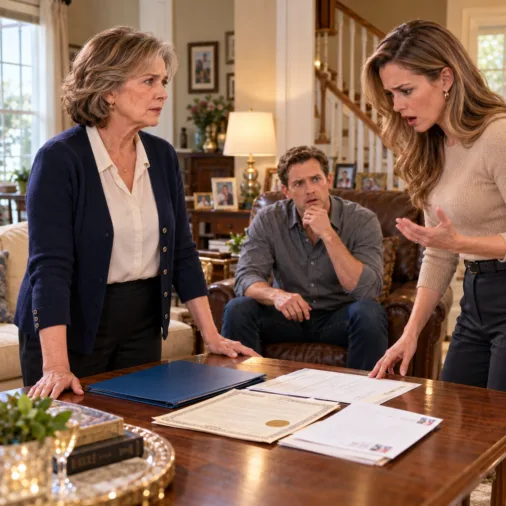
“I changed my estate plan.”
The room became quiet.
I had not planned to tell them that day.
Then I remembered that secrecy had helped create the problem.
Not my secrecy alone.
But vagueness.
Assumptions.
Half-understood promises.
I decided clarity was better.
Matthew swallowed.
“Okay.”
“You are still a beneficiary.”
His face tightened with shame.
“You don’t have to tell me.”
“I know. I’m choosing to.”
He nodded.
“You are no longer my financial agent or successor trustee.”
“I understand.”
“The house will be sold after I die, unless I change my mind later.”
Jessica looked down at her hands.
“Neither of you will inherit the house itself.”
Matthew inhaled slowly.
“Okay.”
“I am not doing that to punish you.”
“I know.”
“Do you?”
He looked at me.
“I think so.”
“I’m doing it because the house became too symbolic. For you. For Jessica. For me. I want it to be my home while I’m alive and an asset after I’m gone. Nothing more.”
He nodded.
“And I’m going to spend some of my money.”
That surprised him.
I smiled.
“I’m serious.”
“On what?”
“Travel. Repairs. Classes. Maybe an irresponsible amount of lemon pie.”
He laughed through tears.
“Good.”
Jessica looked at me.
“What if you need help later?”
“Then I will ask.”
“What if you can’t?”
“My documents name people to help.”
“Not Matthew.”
“No.”
She flinched slightly.
I did not soften the truth.
“Trust can come back,” I said. “Authority does not have to come back at the same speed.”
Matthew nodded.
“That’s fair.”
We ate dinner.
It was not perfect.
Jessica and I were careful with each other.
Matthew overcompensated by offering to clear every plate.
At one point he asked whether he could put leftovers in the refrigerator and all three of us started laughing because the question was so cautious.
After dinner, we opened no gifts.
We had agreed not to exchange any.
Instead, I brought out the old photo album.
We found the first-house Christmas picture.
Matthew laughed at his missing teeth.
Jessica stared at George’s handwriting on the back.
OUR HOUSE. OUR BOY. OUR BEGINNING.
She touched the words.
“I understand why you were so upset,” she said.
I looked at her.
“I wasn’t upset because the decorations changed.”
She nodded.
“I know.”
That was enough for the moment.
At eight, they put on their coats.
Matthew stood by the door.
“Can I ask one thing?”
“Yes.”
“Will you ever give me a key again?”
I looked at him.
The old answer would have been immediate.
Of course.
The new answer took its time.
“Maybe.”
He nodded.
“Okay.”
“Trust is not a Christmas present.”
A faint smile crossed his face.
“No.”
“You earn it in ordinary days.”
He opened the door.
“Then I’ll start tomorrow.”
After they left, I locked the door.
Not against them.
For me.
That distinction had finally become clear.