MY EIGHT-YEAR-OLD SON DREW A GIANT ARROW ON MY GRANDMOTHER’S MANSION WALL. THEN HE SAID MY BROTHER ALREADY KNEW WHAT WAS INSIDE THE SAFE
Chapter 2 2/6
The Key in Ethan’s Pocket
The brass key fit.
That did not mean the safe opened.
When I inserted it beneath the dial, the mechanism clicked, but the handle would not move.
Ethan leaned closer.
“It needs numbers.”
James immediately said, “Enough.”
I ignored him.
The dial was old, with numbers from zero to ninety-nine.
I had expected something simple: Margaret’s birthday, my grandfather’s birthday, the year the house was built.
But my grandmother had never been a simple woman.
I tried her birthday anyway.
Nothing.
Her wedding anniversary.
Nothing.
Ethan watched me fail three combinations before he said, “Dad?”
“Yes?”
“She told me you’d know.”
A painful little laugh escaped me.
“She overestimated me.”
“No. She said you’d know when you stopped thinking about money.”
That sentence sounded exactly like Margaret.
I closed my eyes.
Behind me, James muttered something under his breath.
I thought about the safe.
About Margaret.
About the year 1969.
My grandfather, Thomas Vale, had moved his young family into Vale House after Vale Tool & Die received the defense contract that transformed a modest Ohio manufacturing company into a regional industrial empire.
At least, that was the family story.
Thomas built the company.
Thomas bought the house.
Thomas created the fortune.
Margaret, according to family mythology, supported him.
That word—supported—had always annoyed her.
At every holiday dinner, some relative eventually toasted “what Granddad built.”
Margaret would smile.
Never correct them.
Never argue.
But once, when I was sixteen, she drove me to an abandoned brick factory on the south side of Cleveland and pointed at a boarded window.
“That was my office,” she said.
I laughed because I thought she was joking.
She wasn’t.
“What did you do there?”
“Everything your grandfather didn’t know how to do.”
She told me she had done payroll, negotiated with suppliers, and convinced her widowed mother to mortgage two rental properties to fund the company’s first expansion.
Then she made me promise never to confuse the loudest person in a story with the person who made the story possible.
I had forgotten that conversation for years.
Now, standing in front of the safe, I remembered the number painted over the factory door.
214.
I turned the dial.
Two.
One.
Four.
Nothing.
Then I remembered Margaret correcting me.
“Not two-fourteen,” she had said. “February fourteenth. Your grandfather proposed to me there because he was too broke to buy dinner.”
Two.
Fourteen.
I tried 2-14-69.
The lock clicked.
Behind me, someone gasped.
The handle moved.
James said my name.
I pulled.
The door opened with a groan.
The inside smelled like cold metal and old paper.
Three shelves faced us.
The top shelf held a stack of black leather accounting books.
The middle shelf contained document boxes, envelopes, and a small metal cash box.
The bottom shelf held three thick binders wrapped in plastic, a portable cassette recorder, several tapes, and a modern silver flash drive sealed inside a clear evidence bag.
A white envelope sat directly in the center.
HENRY was written across it in Margaret’s handwriting.
Under my name she had added four words.
IF JAMES SAYS I FORGOT.
I heard Vivian whisper, “Oh, dear God.”
James lunged.
Not at me.
At the envelope.
I caught his wrist before his fingers reached it.
For a second we stood frozen beside the open safe like two boys fighting over something our grandmother had told us not to touch.
Except we were not boys anymore.
James was thirty-nine.
I was forty-three.
And my son was watching us.
“Let go,” James said.
“Why?”
“That letter concerns me.”
“My name is on it.”
“You don’t know what she wrote.”
“Exactly.”
He tried to pull away.
I held on.
James lowered his voice.
“Henry. You have no idea what you’re doing.”
“No. I’m starting to think that’s been the problem.”
I released him and took the envelope.
He stepped back.
Ethan slipped his hand into mine.
The gesture almost undid me.
I opened the letter.
Henry,
If you are reading this, I am dead or James finally became brave enough to tear down my wall himself.
If he has told you I was confused, ask him why confusion made me move my original documents out of his reach.
If he has told you the house must be sold, read the trust dated October 3, 1989.
If he has told you he is the sole managing trustee, compare the signatures.
If he has told you the money is safe, open the black ledger marked 2019.
Do not protect him because he is your brother.
Do not destroy him because you are angry.
Find the truth first.
Then decide what kind of family you want Ethan to inherit.
Love,
Grandma
My hands shook.
Not dramatically.
Barely.
But enough that the paper made a soft sound.
James saw it.
“So she poisoned you against me.”
I looked up.
“Which part is poison?”
“She had become obsessed.”
“With what?”
“Control.”
I almost laughed.
“You just told everyone she gave you control.”
His mouth tightened.
“That isn’t what I meant.”
I handed the letter to Ethan’s godmother, Nora Brooks.
Nora was not a relative.
She was an attorney who had known Margaret for twenty years and had attended the memorial because my grandmother had once funded the legal clinic where Nora started her career.
I trusted her more than anyone in the room.
“Read the trust,” I said.
James turned.
“Nora has no role in this.”
Nora accepted the letter.
“She does now.”
“This is family business.”
“It stopped being family business when you told thirty people the house had to be sold because the estate couldn’t carry it.”
James looked around.
That morning, he had indeed announced that Vale House would be listed within thirty days.
He had described it as painful but necessary.
The estate, he said, was asset-rich and cash-poor.
Taxes were rising.
Maintenance costs were unsustainable.
Margaret had understood.
Margaret had agreed.
Margaret had authorized him to act.
My aunt Vivian had cried.
Two cousins protested.
James had displayed a copy of an amendment to the Vale Family Trust naming him sole managing trustee.
I had barely looked at it.
That shame hit me harder than anything else.
I had accepted his explanation because I had become accustomed to accepting explanations.
Nora removed the 1989 trust from the safe.
The document was more than an inch thick.
Original signatures appeared on the last pages.
Thomas Vale.
Margaret Vale.
Three trustees from Lakeshore Fiduciary Bank.
Nora read silently.
Then she looked at me.
“Henry.”
“What?”
“Vale House isn’t part of Margaret’s probate estate.”
James swore softly.
Nora continued.
“It was transferred into the family trust in 1989.”
Vivian frowned.
“What does that mean?”
“It means Margaret did not personally own this house when she died.”
James said, “We know that.”
I looked at him.
“You told us the estate had to sell it.”
“I was simplifying.”
Nora ignored him.
“The trust owns it. Under this version, selling a principal family property requires approval from both primary beneficiary branches and an independent trustee.”
“Beneficiary branches?”
“You and James.”
I stared at her.
“So he can’t sell it alone.”
“Not under this.”
James stepped closer.
“There was an amendment.”
“2018,” Nora said.
“Yes.”
Nora looked toward the open safe.
“Margaret specifically told Henry to compare the signatures.”
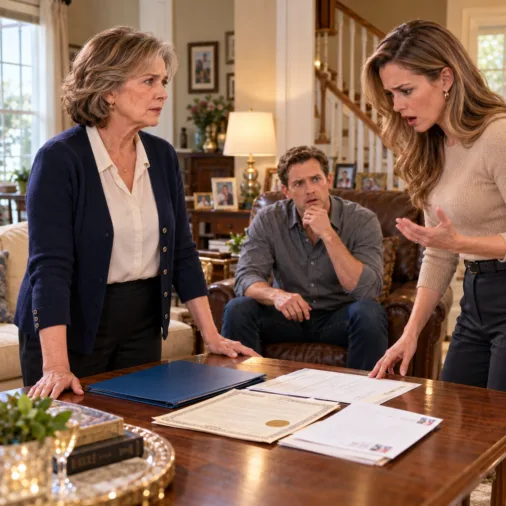
We found the amendment in the folder James had brought to the memorial.
His copy appeared clean.
Professional.
Margaret’s signature sat above a notary seal.
Nora placed it beside the signatures on the original trust and several letters from 2018.
At first, I saw nothing.
Then I did.
My grandmother always made the final stroke of the M in Margaret longer than the first.
The amendment did the opposite.
“That doesn’t prove anything,” James said.
Nora looked at the notary.
“Do you know a Patricia Lorne?”
“No.”
I did.
“She worked for Vale Holdings.”
James looked at me.
I remembered her now because Patricia had been Rebecca’s favorite person in accounting. She retired suddenly in late 2019.
Nora checked the seal date.
“December 12, 2018.”
Something cold moved through me.
Margaret had been in Florida that week.
I knew because Ethan had been born on December 10, and Margaret had flown to Florida two days later for her oldest sister’s funeral.
“She wasn’t in Ohio,” I said.
James’s face hardened.
“You don’t know what day she signed.”
“The notary acknowledgment says she personally appeared on December twelfth.”
“That could be an error.”
“Convenient error.”
“Henry—”
I walked to the safe.
The black ledger marked 2019 was heavy.
Margaret’s handwriting filled the first pages.
Dates.
Wire amounts.
Account numbers.
Corporate names.
Beside some entries she had drawn red question marks.
STONEBRIDGE ADVISORY LLC — $2,400,000
WESTFIELD LAND PARTNERS — $1,850,000
CROWN RIVER SERVICES — $975,000
Another page.
Another.
Transfers from accounts belonging to the Vale Family Investment Trust.
By the end of 2021, the figures passed eight million dollars.
By 2023, more than twelve.
“What is Stonebridge?” I asked.
James said nothing.
I looked up.
“What is Stonebridge?”
“An investment entity.”
“Whose?”
“Vale Holdings.”
Nora shook her head.
“This ledger says Margaret searched the Ohio business registry.”
James snapped, “She searched everything.”
Nora pointed at a note.
“She wrote that Stonebridge was registered to a law firm that formed private entities on your instructions.”
“So?”
“So I’m asking again,” I said. “Whose company is it?”
He folded his arms.
“You don’t understand the structure.”
“Then explain it.”
“This is exactly why Margaret should not have been digging through financial records without context.”
The sentence came out before he could stop it.
Everyone heard it.
Margaret had not been confused.
Margaret had been investigating.
I looked toward Ethan.
My son was staring at the flash drive inside the safe.
A small paper label had been taped to it.
J.V. — OFFICE — APRIL 6
I knew what J.V. meant.
James Vale.
“Dad,” Ethan said.
James saw the label too.
He moved toward the safe.
Nora shut the steel door halfway with her hip.
“No.”
James stared at her.
“You have no authority to withhold family property.”
She smiled without warmth.
“You seem very interested in authority today.”
I removed the flash drive.
James’s voice dropped.
“Do not plug that into anything.”
“Why?”
“You don’t know where it came from.”
“Grandma labeled it with your initials.”
“That proves nothing.”
Ethan looked up at me.
“Is that the thing she copied?”
I froze.
“What thing?”
He pointed at the drive.
“When Uncle James left.”
James’s face went blank.
I crouched beside Ethan.
“What did Grandma copy?”
He shrugged.
“I don’t know. She told me to play in the hall. Uncle James was in her office, and after he left she put a little silver thing in her pocket.”
“When was this?”
Ethan thought.
“The day he yelled.”
I looked at James.
He was no longer angry.
He was calculating.
That scared me more.
He stepped toward me.
“Henry, listen carefully. There are company records on that drive. Confidential records. If you open them in front of everyone, you could cause serious damage.”
“To whom?”
“To all of us.”
For the first time since the wall came down, he sounded sincere.
Not innocent.
Sincere.
“There are things you don’t understand about what happened after Dad died,” he said. “Things Margaret never had to manage because I was the one keeping the company alive.”
“You moved twelve million dollars.”
“You read handwritten notes and decided you know what happened.”
“Did you move it?”
He looked around the room.
The family was watching.
Employees of Vale Holdings were there too. Old friends. Advisers.
His reputation, built over years, was collapsing one question at a time.
James turned back to me.
“Yes.”
The answer hit harder because he did not deny it.
“But if you think I stole twelve million dollars,” he continued, “you’re wrong.”
“Where did it go?”
“To keep Vale from collapsing.”
The room erupted.
Questions.
Accusations.
Disbelief.
James raised his voice.
“You want the truth? Fine. Ask Henry where he was when Dad left us with eighty million dollars in hidden debt.”
I stared at him.
“What?”
James pointed at the safe.
“You think that box contains one secret?”
His eyes met mine.
“It contains the reason I had to start lying in the first place.”