My Son and His Wife Blew Through $620,000—Then She Slapped Me When I Refused to Hand Over My House
Chapter 2 2/7
THE RECEPTION THAT NEVER STARTED
The nurse who examined my wrist was named Caroline Shaw.
She had been seated at table twelve with her husband, one of Noah’s coworkers. The moment she saw me fall, she crossed the room without waiting to be asked. She checked my wrist, elbow, pupils, and the movement in my fingers, then pressed gently around my hip.
“I don’t feel anything that screams fracture,” she said, “but that is not the same as saying you’re fine.”
“I’m seventy-seven,” I told her. “Something always hurts.”
Caroline did not laugh.
“Then let’s not add a preventable injury to the list.”
Noah asked if we needed an ambulance.
I said no.
Caroline said I should be evaluated if the pain increased, if I became dizzy, or if I had trouble walking. Noah listened to every word as if she were giving him instructions for dismantling a bomb.
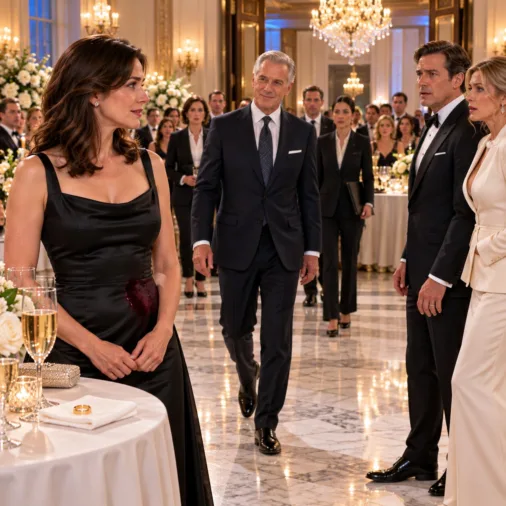
Brittany stood ten feet away with her mother and two bridesmaids.
Nobody had resumed the music.
Nobody had touched the champagne.
The room had the strange frozen quality of a stage after someone forgets the next line.
Samuel spoke quietly into his radio. Staff began stepping back from service positions. The bartenders stopped opening bottles. Servers carrying trays returned toward the kitchen. The lighting remained on, but the celebratory machinery of the reception slowed to stillness.
Brittany noticed.
“What are they doing?”
Samuel turned toward her. “Following the groom’s direction.”
“The groom doesn’t own your company.”
“No,” Samuel said. “I do.”
Diane’s jaw tightened. “Mr. Bennett, we have paid a substantial amount of money for tonight.”
“And your agreement contains provisions for interruption, cancellation, safety, and conduct.”
“Are you threatening us?”
“I am explaining why my staff will not proceed while a guest who has just fallen is being evaluated and the groom has explicitly ended the reception.”
“This is outrageous.”
Samuel’s expression did not change. “No. It is unfortunate.”
That difference seemed to infuriate her.
Noah took my handbag from one of the assistants who had collected my belongings. He crouched and placed each item back inside carefully.
My reading glasses.
Comb.
Peppermints.
Lipstick.
Then he found the photograph of Thomas.
It was an old picture, taken in our backyard the summer before he got sick. Thomas was standing beside the grill in a ridiculous apron that said KISS THE COOK OR DO THE DISHES. His hair was windblown. He was laughing at something outside the frame.
Noah held the photo for a moment.
“Dad?” he asked.
“I always carry him to important things.”
His throat moved.
Then he slid the photograph back into the inside pocket and fastened the clasp.
“I’m sorry,” he said.
“You did not do this.”
“I should’ve seen it.”
“Seen what?”
He looked across the room at Brittany.
I knew the answer before he said it.
“All of it.”
I touched his sleeve. “Today is not the day to judge your whole life by one terrible minute.”
“Was it one minute?”
I did not respond.
He looked at me.
“Mom.”
There are questions children ask when they are young because they expect a simple answer.
Why is the sky blue?
Where do birds sleep?
Why do people die?
There are other questions grown children ask their parents that are much harder because the truth might alter the life they have built.
Was it one minute?
I had spent two years telling myself that Brittany’s behavior toward me was not important enough to mention.
She forgot to include me in Thanksgiving planning because she was overwhelmed.
She seated me with Noah’s office staff at their engagement dinner because her family had “complicated dynamics.”
She asked me not to bring my homemade pie to Christmas because the dessert table had a visual theme.
She returned the baby quilt I made for her cousin’s shower because “handmade gifts can feel very personal.”
She corrected me when I called Noah during their vacation, though he had asked me to call.
She once laughed at my old car and said, “Grace has made frugality into a personality.”
None of those things seemed worth making Noah choose between peace with his wife and defending his mother.
So I smiled.
Changed subjects.
Left early.
Told myself that Brittany was young, particular, ambitious, stressed.
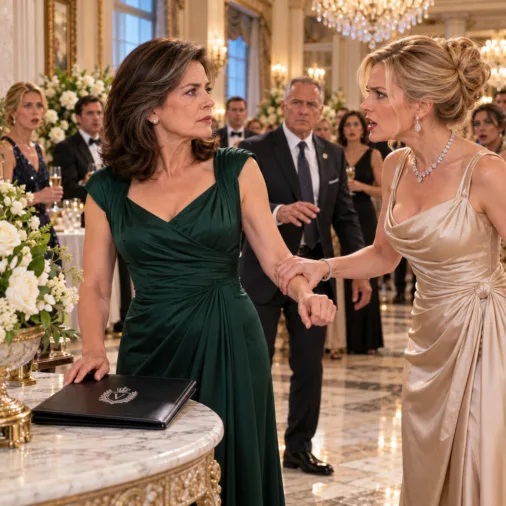
Now I was standing beside a platform from which she had physically pulled me after telling me I made her wedding look cheap.
And my son was asking whether this had truly begun today.
“No,” I said.
His face tightened.
“How long?”
“Noah—”
“How long, Mom?”
I looked at the floor.
“Small things. A couple of years.”
He closed his eyes.
“What small things?”
“This is your wedding day.”
“Apparently not anymore.”
The words hurt me for him.
“You don’t need to decide anything while you’re angry.”
“I need to know whether you’ve been protecting me from my own wife.”
Before I could answer, a microphone squealed near the bandstand.
Everyone turned.
Brittany was standing beside the DJ booth with the wireless microphone in her hand.
Her mother was whispering urgently to one of the coordinators, who looked as though she wanted to vanish.
“Everyone,” Brittany said.
Her voice trembled only slightly.
“I’m so sorry for the delay. We had a minor family incident during photographs.”
Noah’s head snapped toward her.
“Brittany.”
She continued.
“Grace lost her balance and unfortunately fell. She is okay, but emotions are high. We’re going to take a few minutes and then continue the celebration.”
A murmur moved across the room.
I stared at her.
Grace lost her balance.
The sentence was neat.
Clean.
Almost elegant.
It removed her hand from my arm.
It removed the insult.
It removed Noah’s anger.
It turned what had happened into an unfortunate accident caused by an old woman’s unsteady feet.
Caroline’s brows rose.
The photographer looked at me.
Samuel became very still.
Noah walked toward the microphone.
Brittany lowered it. “Please don’t.”
“You just lied to everyone.”
“I’m trying to keep this from becoming humiliating.”
“For who?”
“Us.”
“You mean you.”
Her eyes hardened. “You’re letting your mother destroy our wedding.”
The words carried farther than she intended.
Several people heard them.
Noah stopped walking.
I felt the familiar instinct to intervene.
To tell him I was fine.
To tell everyone to eat.
To let the evening happen.
To absorb the insult because three hundred people had dressed up and driven across town and bought gifts, and because a wedding cost too much money to throw away.
Then I remembered Brittany’s hand tightening around my arm.
I remembered the edge of the platform disappearing beneath my foot.
I remembered her calling for security after I fell.
And I realized something uncomfortable.
Keeping peace can become a habit so powerful that eventually you are not preserving peace at all.
You are preserving permission.
“Noah,” I said.
He turned.
I had always taught him not to make permanent decisions in temporary anger.
But I had also taught him that dignity mattered.
So I said something different.
“Do not make a decision for me.”
He stared at me.
“If you stay, stay because you believe in this marriage. If you leave, leave because you don’t. I will be all right either way.”
His shoulders lowered by perhaps half an inch.
Brittany gave a short, disbelieving laugh. “Of course. Very noble.”
I looked at her.
It was the first time that day I spoke directly to her without trying to soften anything.
“No, Brittany. Noble would have been walking away when I tried to leave the picture.”
Her mouth opened.
I continued.
“You didn’t need to like my dress. You didn’t need to want my handbag in your photographs. You did need to keep your hands to yourself.”
Diane stepped forward. “Grace, no one pushed you.”
“I did not say pushed.”
The distinction mattered.
Brittany had been repeating the word pushed because it sounded dramatic and therefore easier to deny.
I had said pulled.
The photographer raised one hand slightly.
“I saw her take Mrs. Carter’s arm.”
Brittany spun toward him. “You were behind a camera.”
“Yes.”
“Then how could you see anything clearly?”
“Because I was photographing the interaction.”
That changed the room.
Not loudly.
But unmistakably.
Brittany’s gaze dropped to the camera hanging at his side.
“What exactly did you photograph?”
He looked uncertain.
“I don’t know yet. I was shooting continuously as Noah reached toward his mother.”
“Give me the camera.”
“No.”
“I hired you.”
“Your contract is with my studio.”
“My mother paid your studio.”
“That does not give you ownership of my equipment.”
Diane moved beside her daughter. “We are not turning wedding photos into evidence.”
Caroline folded her arms. “Nobody said evidence.”
Diane’s face flushed.
Samuel looked at the photographer. “Elliot, back up your files.”
The photographer—Elliot—nodded.
Brittany stepped toward him. “Absolutely not.”
Noah moved between them.
“Do not touch his camera.”
“Are you hearing yourself?” she asked. “You’re treating me like some criminal because your mother tripped.”
“She didn’t trip.”
“You didn’t even see it.”
“I saw your hand on her.”
“You saw the end of it.”
“And I heard you say she didn’t know her place.”
Brittany looked around the room, perhaps hoping for an ally.
Her bridesmaids avoided her eyes.
One of them, a woman named Paige, finally said, “Britt, maybe we should go upstairs.”
Brittany ignored her.
Diane tried another approach.
“Noah, you’re exhausted. Everyone is emotional. Come with us for ten minutes. We’ll sit privately. Grace can get checked. The guests can have cocktails.”
Noah glanced at me.
Then at Samuel.
Then at the ballroom doors where hundreds of guests waited in clusters, whispering.
“I already told you,” he said. “The reception is over.”
Diane’s face hardened.
“Do you have any idea what this is going to cost?”
Noah gave a tired, humorless smile.
“I think we’ve established that cost matters a lot to this family.”
That landed.
Brittany’s eyes filled with tears.
For the first time, I felt a pull of sympathy.
Not because she was right.
Because endings are terrible even when they are necessary, and I had never wanted my son’s marriage to fracture before the cake was cut.
She looked at him and lowered her voice.
“Are you really going to throw away our entire marriage over her?”
There it was.
Not over what I did.
Over her.
Noah stared at his wife.
“No,” he said. “I’m asking whether the marriage was already something else and I refused to see it.”
Brittany’s tears stopped as quickly as they had begun.
“You always choose her.”
He shook his head slowly.
“No. That is what you keep telling yourself whenever basic respect interferes with what you want.”
She flinched.
Diane grabbed her daughter’s hand. “We are not doing this here.”
But Brittany pulled away.
“You want the truth?” she asked Noah. “Fine. Your mother has judged me since the day we met.”
I almost laughed from surprise.
“When?” I asked.
She turned on me. “Every time you show up in those thrift-store clothes and act like money doesn’t matter. Every time you make some homemade thing instead of buying what’s on the registry. Every time you give Noah that look like you’re the only woman who really knows him.”
I stared at her.
My dress was not from a thrift store, although I would not have been ashamed if it were.
My handmade gifts had never been intended as criticism.
And the look she meant was probably the same look I had given Noah from the time he was small: I see you.
Brittany continued.
“You make people feel tacky for enjoying nice things.”
“I have never criticized your wedding.”
“You don’t have to. You stand there looking modest and everyone thinks you’re better.”
“That is not something I can fix for you.”
Her face changed.
Noah whispered, “Mom.”
But I was done disappearing.
“I lived carefully because your father-in-law had cancer twice before he died. We learned what uncertainty costs. I kept the same car because it runs. I carry an old handbag because my husband gave it to me. I wear my mother’s pearls because she cannot be here to wear them herself. None of that is a judgment of you.”
The room was silent again.
“You decided my life was an insult to yours,” I said. “That was never my decision.”
Brittany looked away first.
At that moment Elliot returned from the side hall carrying his camera and a tablet.
“I backed everything up,” he said.
Samuel nodded.
Noah asked, “Did you see the sequence?”
Elliot hesitated.
“Yes.”
Brittany’s head turned.
“What does it show?”
He did not answer her.
He looked at me.
“Mrs. Carter, there are several frames. One of Noah reaching for you. One when you step back. Another when Brittany’s hand is on your arm.”
“And the fall?” Noah asked.
Elliot swallowed.
“Yes.”
Brittany’s face drained.
Her mother spoke first.
“Delete them.”
Every head near us turned.
Diane realized what she had said and tried to correct herself.
“I mean the unflattering ones. Nobody needs photographs of an accident.”
Elliot held the tablet closer to his chest.
Noah looked at his new mother-in-law.
“Why would you want them deleted if Grace simply lost her balance?”
Diane said nothing.
Samuel’s radio crackled.
A staff member’s voice came through quietly.
“Mr. Bennett, we have a situation at the south entrance. Mrs. Carter’s fall is already on social media. Someone posted a short video.”
I felt cold.
Noah looked at Samuel. “What video?”
Samuel lifted the radio. “Do we know what it shows?”
A pause.
“Not the fall clearly. It starts afterward. The bride is saying Mrs. Carter doesn’t know her place. Then she calls security.”
Brittany closed her eyes.
The wedding had ended.
But the public story of why it ended had just begun.
And before that night was over, Brittany would make one more choice that would turn a humiliating family disaster into something none of us could quietly contain.