My Daughter-in-Law Told an Airport Full of Strangers She Paid for Our $12,000 Vacation—So I Removed My Card and Let Her Prove It
Chapter 4 4/6
The Truth About the Seating Chart
I did not sleep much after Paige’s message.
Toby didn’t make that decision first. I did.
I read it until the words lost shape.
At 7:12 the next morning, I was already in the kitchen when Paige called.
I answered.
“Come over,” I said.
She arrived twenty minutes later wearing jeans, an old college sweatshirt, and no makeup. She looked nothing like the polished woman who had stood beneath chandeliers the night before. Her eyes were swollen.
I poured coffee for both of us.
She wrapped her hands around the mug but did not drink.
“I am sorry,” she said.
“I know.”
“No, I don’t think you do.”
“Then tell me.”
She stared at the table.
“A week ago, Mom changed the head table.”
I waited.
“Originally it was you, Toby, me, Mom, Marcus, Aunt Lila, and two of Toby’s oldest friends. Then Mom said Toby’s boss needed to sit there. Then his wife. Then she wanted a client beside him. Then another couple.”
“And me?”
“You were still there at first.”
At first.
The phrase made something cold move through me.
Paige continued.
“Mom said the head table was becoming too crowded. I said we could move Marcus. She said that would embarrass her. I said we could put her sister somewhere else. She said that would create drama. I said we could make the table longer.”
“What did she say?”
“That the layout wouldn’t photograph correctly.”
I closed my eyes.
Photographs.
Of course.
“So whose name did you remove?”
Paige started crying.
“Yours.”
I looked at her.
She rushed to explain.
“Only from the head table. I thought we would put you beside Claire at the family table. I swear. I thought that was what we were doing.”
“Why mine?”
She wiped her cheek.
“Because I knew you wouldn’t yell at me.”
The honesty was so brutal I could not answer immediately.
Not because I mattered least.
Because I was safest to hurt.
That was a different kind of pain.
Paige looked at me.
“I hate that I just said that.”
“You should.”
She nodded.
“I do.”
I sat back.
“What happened after that?”
“Mom saw the chart. She said it looked insulting to put the groom’s—” Paige stopped herself and gave a sad laugh. “I almost said groom. I’ve been thinking about weddings all morning because she did the same thing at ours.”
“Did what?”
“Made every decision sound like an emergency until everyone gave up.”
I remembered Toby and Paige’s wedding twelve years earlier. I had been allowed to choose my dress and almost nothing else. At the time I told myself that was normal.
Paige continued.
“Mom said it would look terrible if Toby’s mother wasn’t at the head table. I said then we should put you back. She said there wasn’t room. Then she said maybe you would prefer not to attend because you had seemed uncomfortable with how large the dinner was becoming.”
“I never said that.”
“I know.”
“Did you tell her that?”
“Not strongly enough.”
That phrase again.
Not strongly.
As though truth required volume to become valid.
“Then what?”
“She asked Toby whether it might be easier to celebrate with you separately.”
“And he said yes.”
Paige nodded.
“Not immediately. He argued for a few minutes.”
That detail should have comforted me.
It did not.
“What did he say?”
“That you planned the dinner. That you would be hurt. Mom said you were already upset about the invitation and would probably criticize the whole night. She said he deserved one birthday without managing anybody’s feelings.”
I stared into my coffee.
“Managing my feelings.”
“I’m sorry.”
“I wanted a chair.”
“I know.”
“I did not ask him to manage my feelings. I asked to attend.”
“I know.”
Paige’s voice broke.
“I should have stopped it.”
“Yes.”
“I was afraid of her.”
I looked at her.
She had said it quietly.
Not annoyed by her.
Not tired of her.
Afraid.
“Has your mother ever hit you?”
Paige shook her head quickly.
“No. Never. It’s not that.”
“Then what are you afraid of?”
“Her disappointment. Her anger. The way she can make every disagreement feel like betrayal.”
That I understood.
Some people did not need to shout to control a room. They only needed everyone around them to believe peace depended on obedience.
Paige rubbed her thumb along the mug handle.
“When I was growing up, if I chose something Mom didn’t like, she would become cold. Sometimes for days. She would say she was fine, but the whole house knew she wasn’t. Then I would apologize, even when I didn’t know for what.”
“And now?”
“Now I do the same thing faster.”
I let that sit between us.
“Paige, understanding why you did something does not erase what you did.”
“I know.”
“But it can help you decide whether you will do it again.”
She nodded.
“I won’t.”
“Don’t promise me. Practice it.”
Her eyes filled again.
I reached across the table and put my hand over hers.
That was not forgiveness.
Not yet.
It was recognition.
I had spent seven years letting fear make decisions for me too.
My fear looked different from Paige’s, but it had produced the same result: surrender first, hurt later.
At 9:30, Toby arrived.
Paige had texted him without asking me.
For one second I was annoyed.
Then I saw his face.
He had not slept either.
He sat beside his wife.
We looked like three people waiting outside a doctor’s office.
Paige told him everything she had told me.
He did not interrupt.
When she finished, he covered his face with both hands.
“I knew about the separate brunch idea,” he said.
“I know.”
“I didn’t know you had been removed from the head table before that.”
“It doesn’t change what you did.”
“I know.”
That phrase was becoming the sound of my family finally stopping its excuses.
Toby looked at Paige.
“Did your mom tell you Mom wanted to skip the dinner?”
“She said Billie was uncomfortable.”
“You told me the same thing.”
“Because I believed her.”
I felt anger rise again.
“Both of you had my phone number.”
They looked at me.
“That is what I cannot understand. You were discussing whether I wanted to attend a dinner I planned. Neither of you asked me.”
Paige whispered, “You’re right.”
Toby nodded.
“I should have called earlier.”
“You should have refused.”
He swallowed.
“Yes.”
The doorbell rang.
All three of us froze.
I did not need to look through the window.
I knew.
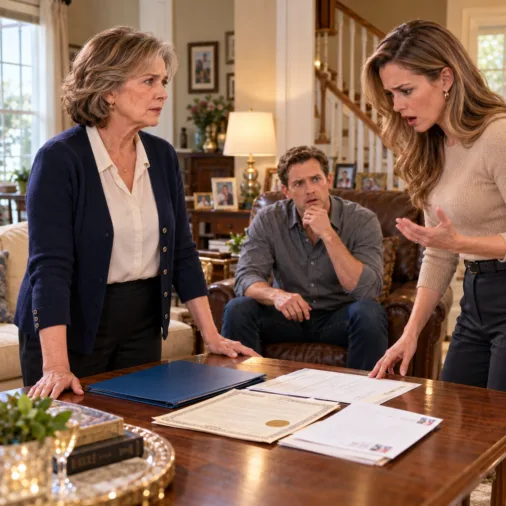
Sherry entered my house carrying the event folder Daniel had given her and enough anger to change the temperature of the room.
She stopped when she saw Toby and Paige at my table.
“So this is where everyone is.”
Paige stood.
“Mom.”
Sherry held up one hand.
“No. I spent half the night dealing with a disaster that did not need to happen.”
I remained seated.
“Good morning, Sherry.”
She looked at me as if politeness were an insult.
“You cost me more than eleven thousand dollars.”
“No. You ordered more than eleven thousand dollars.”
“The party was for your son.”
“Then why was my name removed from it?”
Her jaw tightened.
“We are not doing this again.”
“We never did it the first time.”
Toby stood too.
“Sherry, sit down.”
She turned.
“Don’t speak to me like that.”
“I am asking you to sit.”
“I don’t need to sit. I need Billie to reimburse me for the services she canceled and the money I had to cover.”
I almost laughed.
“The services I canceled were services you did not have to pay for.”
“They were planned.”
“They were unauthorized.”
“You knew about the event.”
“I knew about an event. I did not approve your spending.”
She opened the folder and pulled out the invitation.
“You let this go out.”
“I objected.”
“You didn’t stop it.”
“I did not know I needed a lawyer to say no to a birthday invitation.”
“Don’t be ridiculous.”
Paige stepped forward.
“Mom, stop.”
Sherry looked at her daughter.
“What?”
“I said stop.”
It was only two words.
Paige’s hands were shaking.
Her voice was not.
Sherry stared at her.
“You’re taking her side?”
Paige’s face changed.
“There shouldn’t be sides.”
“There are always sides when someone publicly humiliates your mother.”
“No,” Paige said. “There are consequences when someone spends another person’s money and then removes her from the event.”
Silence filled the kitchen.
I watched Sherry’s face.
For the first time since I had known her, she looked less powerful than surprised.
Paige had broken the rule.
She had disagreed clearly.
Sherry recovered quickly.
“I was trying to make Toby’s birthday successful.”
Toby spoke.
“It was supposed to be Mom’s gift.”
Sherry turned to him.
“And I made it better.”
“Did you?”
“Of course I did.”
“For who?”
Her expression hardened.
“For you.”
Toby shook his head.
“I didn’t ask for seventy-two people.”
“You wanted your boss there.”
“I wanted my boss there. I didn’t ask for half your contact list.”
“They were useful people for you to meet.”
“It was my birthday, not a conference.”
“Now you’re being ungrateful.”
There was the word.
Ungrateful.
A word that had probably controlled Paige for thirty-five years.
Toby looked at his wife.
Then at me.
Then back at Sherry.
“I am grateful for people who care about me. I am not grateful for what happened to my mother.”
Sherry laughed once.
“Your mother created that scene.”
“No. She refused to pay for it.”
The room went quiet again.
I saw something pass across Sherry’s face.
Not remorse.
Not yet.
More like the shock of discovering that a door she had always been able to open had suddenly been locked.
She looked at me.
“You always resented me.”
I considered the accusation.
“No.”
“You did.”
“I envied you sometimes.”
That surprised everyone, including me.
Sherry blinked.
“You had Paige nearby. You had grandchildren in your house more often. You were included in plans I heard about afterward. I envied that.”
Her shoulders relaxed a fraction, as though she had finally heard something she could use.
“But envy is not the same as resentment,” I continued. “I did not want your place. I wanted mine.”
She stared at me.
“I never told anyone you couldn’t have a place.”
“You told them I would be uncomfortable.”
“You were uncomfortable.”
“I was uncomfortable with the spending.”
“You criticized everything.”
“I asked questions.”
“You made the whole event harder.”
“I planned the original event.”
Sherry’s mouth tightened.
“Your original event was too small.”
“For you.”
“For Toby’s life now.”
Toby interrupted.
“What does that mean?”
Sherry hesitated.
He stepped closer.
“No. Say it.”
She looked at him.
“You are not ten anymore. You’re successful. You have people around you who matter. You cannot keep organizing your life around old memories.”
The words landed harder than she intended.
I knew because even she looked startled by them.
Toby’s face went still.
“Old memories like my father?”
“I didn’t say that.”
“You didn’t have to.”
“That’s unfair.”
I stood.
“No,” I said. “It is honest.”
Sherry turned to me.
I held her gaze.
“Leon was not an obstacle to Toby’s success. His recipe did not make the room cheap. My twenty-four guests were not an embarrassment. And I was not a problem to remove because I remembered why the dinner existed.”
She gathered her folder.
“This family has become impossible.”
Paige’s chin lifted.
“No. We became clear.”
Sherry looked at her daughter for a long moment.
Then she walked toward the door.
Before leaving, she turned to Toby.
“You’ll regret letting one ugly night damage this family.”
Toby’s answer was quiet.
“The damage happened before last night.”
The door closed.
Nobody moved.
Then Paige sat down and began to cry.
Toby put his arm around her.
I made more coffee.
It was such an ordinary action that I almost laughed.
The crisis did not end with a dramatic speech.
There was no applause.
There was only morning light across my kitchen table and three people trying to learn a new way to sit together.
Before Toby left, he asked if I still wanted brunch the following weekend.
“No,” I said.
His disappointment showed.
“Not because I never want to see you.”
He waited.
“Because I don’t want you to repair this with a replacement meal.”
He nodded slowly.
“What do you want?”
I thought about it.
“I want you to notice before I disappear.”
His eyes filled.
“I can do that.”
“You can try.”
He hugged me before he left.
I hugged him back.
But that afternoon, when I opened my purse and saw the birthday card, I did not call him.
I still was not ready.
Instead, I took the card to Leon’s grave.
The cemetery was quiet except for wind in the maples.
I sat on the grass beside his stone and read the note aloud.
“Dear Toby,” I began.
My voice broke on the second sentence.
By the time I reached the last line, I understood why I had not been able to give it to him.
The card did not only contain a memory of his father.
It contained a promise I had made to myself without realizing it.
And I was not sure my son had earned the right to hear it yet.