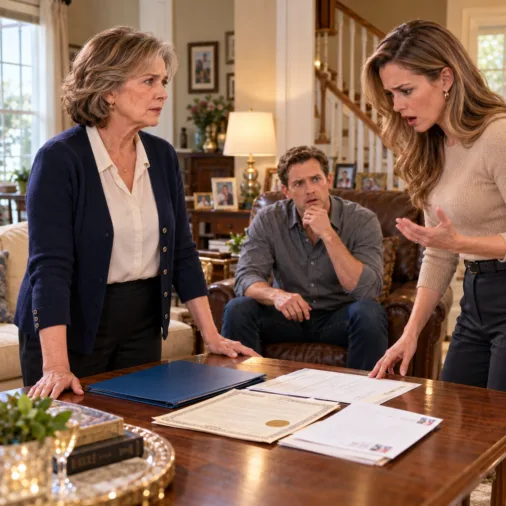
MY SON TOLD ME TO SELL MY HOME FOR HIS $150,000 DOWN PAYMENT—SO I CANCELED CHRISTMAS AND FOUND THE APPOINTMENT HE NEVER TOLD ME ABOUT
Chapter 1 1/6
The Family That Arrived Without Asking
My son moved his wife and children into my house without permission on a Tuesday evening, and by Thursday morning his wife was calling me selfish because I would not cancel my plans to babysit for her.
At sixty-eight, I had spent almost my entire adult life making room for other people. I made room for a husband who worked long hours and came home exhausted. I made room for a little boy who became a teenager, then a man, then a husband and father who still somehow expected that his mother would know how to fix whatever life put in front of him. I made room for aging parents, school fundraisers, scraped knees, college applications, hospital waiting rooms, holiday dinners, and every emergency that seemed to arrive after midnight.
I did not resent those years. Most of them were good years. Some were wonderful. But after my husband, Thomas, died, I discovered something I had almost forgotten existed.
Silence.
Not lonely silence. Not the hollow silence of the first year after a funeral, when every room seems to be waiting for a voice that will never return. I meant peaceful silence. The kind that lets you hear birds in the live oaks. The kind that makes tea taste better because no one is shouting from another room asking where their shoes are. The kind that allows a woman to sit beside a bright window with a novel and realize she can read three chapters without being interrupted.
My house stood outside Charleston behind white columns and flowering hydrangeas, a warm brick home Thomas and I had bought when Julian was still in elementary school. We had refinished the floors ourselves. Thomas had built bookshelves into the den because he said my paperbacks were taking over the house. The oak trees had been skinny then. By the time I was widowed, their branches shaded most of the back lawn.
I had no intention of leaving that house.
That mattered later.
On that Tuesday, I had just finished watering the hydrangeas when I heard tires on the gravel driveway. I expected the delivery van that was bringing a new lamp for the guest room. Instead, a dark SUV rolled past the mailbox and stopped beside my porch.
Julian climbed out first.
He was forty-one, still handsome in the careless way he had been at twenty-five, with his sleeves pushed up and his hair looking as though he had run his hands through it all afternoon. Before he even said hello, he opened the back hatch.
Suitcases appeared.
Then plastic storage bins.
Then two cardboard boxes.
I stood at the edge of the porch holding my watering wand and watched him unload half a household.
Brooke stepped out of the passenger side wearing a cream trench coat that probably cost more than my first refrigerator. She looked toward the house, then toward Julian, and sighed as if she had just arrived at a motel with disappointing reviews.
Lily and Mason climbed out of the back seat.
My annoyance disappeared for exactly three seconds, because my grandchildren ran straight toward me.
“Grandma!”
Lily was nine and all elbows and freckles. Mason was six and had the solemn expression of a child who always seemed to be thinking about dinosaurs, pancakes, or both. I bent to hug them, kissed the tops of their heads, and asked if they were all right.
“They said we’re living here,” Mason announced.
Julian laughed too quickly.
“Not living here. Staying here.”
That was the first moment I felt something tighten in my chest.
I looked at my son. “Staying here?”
He pulled a suitcase from the cargo area. “Mom, the closing on our new place has been postponed. It’s a mess. We’re staying for a few weeks.”
He said it the way a person says the weather has changed.
No question.
No apology.
No, Would that be all right?
Before I could answer, Brooke passed me with a garment bag over one shoulder and walked through my front door.
“Julian, put the blue bins upstairs,” she called. Then, from inside my hallway, she shouted, “Margaret, what’s your Wi-Fi password?”
I stared at the open doorway.
I remember thinking that if I had seen the scene in a movie, I would have laughed because no grown woman could possibly enter another grown woman’s house and start issuing instructions without first asking whether she had permission to stay.
Yet there I was, standing beside my own hydrangeas, holding a garden hose while my family moved in around me.
I should have stopped it then.
That is easy to say now.
But family has a way of training you to ignore the first small violation because objecting feels rude. We tell ourselves that hospitality matters. We tell ourselves children need stability. We tell ourselves that a loving mother does not make her son stand in the driveway while he is having a housing problem.
So I stepped aside.
Not because I had agreed.
Because I had not yet remembered that failing to object is not the same thing as consenting.
Within twenty minutes, my quiet house looked as though an airport baggage carousel had exploded inside it. Jackets landed over the backs of chairs. Charging cables crossed my kitchen counters. Shoes appeared beside the stairs. Mason’s backpack blocked the hallway. Brooke set a large designer tote on the antique console table Thomas’s mother had given us and used it as a dumping place for receipts, sunglasses, and a half-empty iced coffee.
I carried Lily’s small overnight bag upstairs because she looked tired.
“Which room?” I asked.
“The pink one,” Brooke called.
I stopped halfway up the stairs.
There was no pink room.
Then I realized she meant my sewing room, which had pale rose curtains.
“That isn’t a bedroom,” I said.
“It has a daybed.”
“It also has my sewing machine, fabric shelves, and boxes I’m sorting.”
Brooke appeared at the bottom of the stairs. “Lily likes pink.”
She smiled as though the matter had been settled.
I looked at Lily.
She gave me the small apologetic shrug children use when they sense adults are fighting about them.
That was enough to make me swallow my answer.
“All right,” I said. “For tonight.”
I emphasized the last two words.
Brooke did not.
The guest room went to Julian and Brooke. Mason slept in the small room Thomas had once used as an office. By seven, my upstairs had been rearranged without anyone ever asking me how I felt about it.
Then came the refrigerator.
Brooke opened it and stared inside.
“You don’t have much food.”
“I have plenty of food.”
“There’s no prepared chicken.”
“I wasn’t expecting six people for dinner.”
“You knew we were coming.”
“No, Brooke. I learned you were coming when your car entered my driveway.”
Julian was behind her, carrying a box. He looked at me with the tired expression of a man who wanted two women to stop creating a problem he might be required to solve.
Brooke lifted a wedge of my favorite brie. “The kids won’t eat this.”
“It isn’t for the kids.”
She ignored that, unwrapped it, cut herself a piece, and reached for crackers.
I watched her eat my cheese while explaining that “we” needed to make a grocery run because the children needed better breakfast options.
“We?” I asked.
She turned toward Julian. “Can you get the other suitcase?”
Then she walked out of the kitchen carrying the brie.
That evening I ordered pizza because I refused to turn an unexpected invasion into a dinner party. Lily told me about school. Mason built a tower from parmesan packets. Julian spent most of the meal scrolling through messages on his phone. Brooke complained twice about the delivery time and once about the crust.
Afterward, I washed my own plate and went upstairs.
As I passed the guest room, I heard Brooke’s voice through the half-closed door.
“We can sleep late tomorrow,” she said. “Your mother can handle the kids.”
I stopped.
Julian answered too quietly for me to catch every word, but I heard him say, “She usually helps.”
Brooke laughed.
“Exactly.”
Something about that laugh stayed with me all night.
I lay in my bed looking at Thomas’s empty side and thinking about the word usually.
Yes, I usually helped.
I had picked up Lily from preschool when Brooke had migraines. I had kept both children for entire weekends when Julian and Brooke attended weddings. I had paid Julian’s phone bill after his company cut bonuses. Then I kept paying it because the family plan was cheaper. I covered his automobile insurance for six months after a job change. Six months turned into three years. I paid for a gas card “temporarily” when they were saving for a house. I kept one streaming bundle because the grandchildren used it. I sent grocery money after an expensive dental emergency. I had even helped Julian finish the last of his college loans years earlier because Thomas had wanted him to begin adulthood without that burden.
Each favor had arrived alone.
That was the trick.
No single request looked outrageous.
Together, they formed a life in which my son had gradually come to believe that the financial floor beneath him was not his responsibility.
It was mine.
I woke before sunrise and made my usual breakfast: Earl Grey tea, toast with orange marmalade, and one boiled egg.
One place.
One cup.
One peaceful plate.
I sat at the kitchen table while the house remained quiet.
For nearly two hours, no one came downstairs.
I read the newspaper.
I answered an email from my book club.
I confirmed a lunch reservation with my friend Diane.
At nine-ten, Brooke finally appeared in silk pajamas, her hair tied loosely on top of her head.
She looked at my empty plate, then at the clock.
“Where’s breakfast for the kids?”
I folded the newspaper.
“The food is in the pantry and refrigerator.”
She stared at me.
“I mean, what did you make them?”
“Nothing.”
“Margaret, they’re children.”
“I am aware.”
“They need breakfast.”
“They have two parents upstairs.”
Her expression changed.
Not dramatically. Just enough that I saw the first clean edge of resentment.
She poured coffee into one of my mugs without asking.
“Julian and I are going downtown today,” she said. “We have errands, and honestly we need a little time to decompress. You’ll have to pick up the kids from daycare at three.”
“I already have plans today.”
She looked at me as though I had answered in another language.
“What plans?”
“Lunch with Diane. Then I’m going to the library.”
“You can do that another day.”
“No.”
She put the mug down too hard.
“Are you kidding me? We’re going through a crisis.”
“Your housing situation does not make me your personal employee.”
The kitchen became very still.
Brooke’s mouth tightened.
“That is unbelievably selfish.”
Julian walked in just in time to hear the word.
“What’s going on?”
“Your mother refuses to help with the kids.”
I looked at him.
“That is not what happened.”
Brooke crossed her arms. “We asked her to pick them up. She says she has lunch plans.”
Julian rubbed his forehead.
“Mom, seriously?”
I waited.
He gave me the same disappointed look he had used at sixteen when I refused to let him borrow the car after curfew.
“Can’t you help us for once?”
For once.
Two words.
That was all it took.
The anger did not explode. It settled.
It became very clear.
I thought of every check I had written, every Saturday I had surrendered, every emergency I had softened, every bill I had quietly absorbed because I loved him.
Then I looked at the grown man standing in my kitchen telling me I had never helped.
I stood.
Brooke must have expected a speech.
Julian probably expected tears.
I gave them neither.
I carried my teacup to the sink, rinsed it, and dried my hands.
“I need about twenty minutes,” I said.
“For what?” Julian asked.
“You’ll see.”
I walked upstairs, took my dark leather suitcase from the closet, and packed.
Three dresses.
Two pairs of trousers.
A sweater.
Walking shoes.
Toiletries.
My book.
My blood-pressure medication.
My phone charger.
Then I opened the small drawer in Thomas’s old desk where I kept spare keys and documents. For a moment I looked at a photograph of him standing beside the ocean in a ridiculous straw hat.
Thomas had been generous.
But he had not been foolish.
I heard his voice in my memory, not as some supernatural message, but because after forty-two years of marriage you know exactly what your spouse would say.
Maggie, help is something you choose. Servitude is something other people choose for you.
I closed the drawer.
When I came downstairs with the suitcase, Brooke was standing in the foyer.
Her eyes dropped to the luggage.
“Where do you think you’re going?”
“On a little vacation.”
She laughed once, sharply. “You can’t just leave us here with the children.”
I looked at her.
“They are your children.”
Julian came out of the kitchen.
“Mom, come on. We need to discuss this.”
“We did need to discuss it,” I said. “Before you brought your entire family into my home.”
His face flushed.
“It’s temporary.”
“Then temporarily buy your own groceries, take care of your own children, and pay for whatever expenses you create.”
Brooke stepped toward me.
“You’re really going to walk out because we asked for help?”
“No. I’m walking out because you moved in without asking, assigned me jobs without asking, spent my money as though it were yours, and called me selfish when I reminded you that I still have a life.”
Julian lowered his voice.
“Where are you going?”
“The coast.”
“For how long?”
“I haven’t decided.”
“Mom—”
I raised one hand.
“Do not call me unless someone is sick or injured.”
Brooke looked almost offended by my calmness.
“What about dinner?”
That question nearly made me laugh.
Instead, I opened the front door.
“There are grocery stores in Charleston.”
Julian followed me onto the porch.
By then, the morning was bright and humid. Cicadas buzzed in the trees. My suitcase wheels bumped over the porch boards.
He caught up beside my car.
“Mom, wait.”
I turned.
He looked less angry now and more uncertain.
Good.
Uncertainty meant he was finally seeing a situation he could not automatically hand back to me.
“We should talk,” he said.
I opened my car door.
“We should have talked yesterday.”
Then I got in and drove away.
I did not know yet that leaving the house would be the easy part.
The harder part would begin when I opened my banking app and saw just how much of Julian’s adult life I had been quietly financing.
And one account, in particular, was about to expose a truth neither he nor Brooke had bothered to tell me.