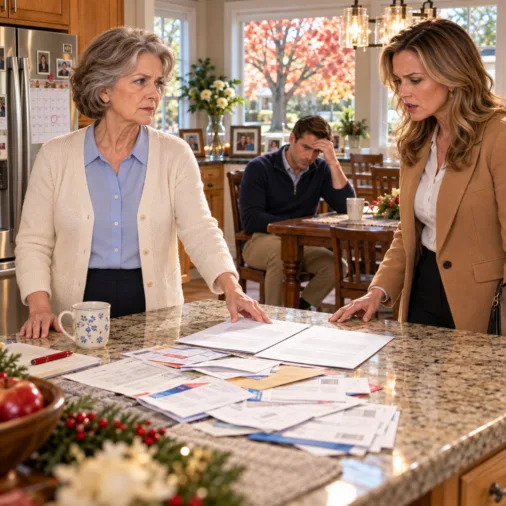
MY SON TOLD ME TO SELL MY HOME FOR HIS $150,000 DOWN PAYMENT—SO I CANCELED CHRISTMAS AND FOUND THE APPOINTMENT HE NEVER TOLD ME ABOUT
Chapter 2 2/6
The First Card I Turned Off
The road toward the coast looked different when I was driving without a schedule.
Marsh grass stretched beside the highway in long green-gold bands. The air changed first, becoming saltier and softer through the cracked window. By late afternoon I reached a small inn near the water, the sort of place Thomas and I used to choose when we wanted the ocean without a crowded resort.
The room had pale blue walls, a white quilt, and a narrow balcony facing the Atlantic.
I set my suitcase down.
Then I sat outside and did absolutely nothing for twenty minutes.
No one asked me for a password.
No one wanted a snack.
No one needed a ride.
No one opened my refrigerator and announced that it was inadequate.
The waves moved in and out with the steady confidence of something that had never once apologized for taking up space.
I ordered crab cakes from the little restaurant downstairs and poured sparkling water over ice. Then my phone buzzed.
Julian.
I watched his name appear until the call stopped.
Thirty seconds later, it rang again.
I turned the phone face down.
I had told him not to call unless someone was sick or injured. If it were an emergency, he could leave a message.
He did not.
Instead, I ate dinner.
At eight-thirty, after sunset had softened the horizon into gray-blue bands, I opened my laptop and banking app.
I did not begin with anger.
I began with facts.
That mattered.
When people have depended on you for years, guilt can make basic arithmetic feel cruel. I needed to see the numbers plainly enough that sentiment could not rearrange them.
First came the family mobile plan.
Thomas and I had added Julian’s line when he was in college. Later Brooke joined. Then two tablets. Then a smartwatch. Somewhere along the way, the account had become my account in name and their communication system in practice.
I moved Julian and Brooke’s lines to “transfer eligible” status and removed automatic payment from my bank. I did not shut off their service. I simply stopped paying for it.
Next came automobile insurance.
Years earlier, Julian had asked to remain under an umbrella policy because the rate was lower. He paid me for a while. Then his company downsized and he missed a month. I covered it. He promised to catch up.
He never did.
I changed the payment arrangement so my account would no longer cover his vehicle after the current period.
Then the gas card.
That card had begun during a rough patch when Mason was a baby and Julian was driving across the state for work. I had told him to use it for two months.
It had been four years.
I suspended the authorized-user card.
Streaming subscriptions came next.
Then a warehouse club membership.
Then the small automatic transfer I sent each month to “help with groceries,” even though Brooke wore new shoes every time I saw her.
I kept a legal pad beside the laptop and wrote each item down.
Phone.
Insurance.
Gas.
Subscriptions.
Groceries.
By the time I finished, the number at the bottom of the page made me sit back.
It was not one enormous expense.
It was worse.
It was a thousand small assumptions.
Money I had spent so gradually that I had stopped noticing it leaving.
I thought about Julian telling me to help “for once.”
My sadness was stronger than my anger then.
I had helped so consistently that my help had become invisible.
That was partly his failure.
It was also partly mine.
I had confused rescuing with loving.
The phone rang at 9:07.
This time I answered.
“Mom!”
Julian sounded breathless.
“Is someone hurt?”
“What?”
“You called. I asked you not to call unless someone was sick or injured.”
“No one’s hurt. My gas card got declined.”
I looked toward the dark ocean.
“Yes.”
“What do you mean, yes?”
“I suspended it.”
There was a short silence.
“Why?”
“Because you are forty-one.”
“That’s not an answer.”
“It is the entire answer.”
“Mom, I was at the gas station.”
“Then use your own card.”
“I had the kids in the car.”
“Julian, you have a bank account.”
He lowered his voice.
“This is ridiculous.”
“No. What was ridiculous was a sixty-eight-year-old widow paying for gasoline in a luxury SUV driven by two healthy adults.”
“It’s not a luxury SUV.”
I almost smiled.
“It has heated rear seats.”
“That’s not the point.”
“You are correct.”
I heard Brooke in the background.
“What did she do?”
Julian covered the phone badly.
“She turned off the gas card.”
Brooke’s voice rose.
“Ask her about the phone.”
I closed my eyes.
Of course they had already discovered that too.
Julian came back.
“Mom, are you cutting everything off?”
“I am stopping the expenses that belong to you.”
“Without warning?”
“You moved four people into my home without warning.”
“That’s different.”
“How?”
“We’re family.”
“Exactly. Family should ask.”
He exhaled hard.
“Look, I know yesterday wasn’t handled perfectly.”
“Yesterday was not handled at all.”
“Can we just talk when you get home?”
“I’m not sure when I’m coming home.”
That frightened him.
I heard it immediately.
“Mom.”
“Yes?”
“We need you.”
There it was.
Not I miss you.
Not I’m sorry.
We need you.
I looked down at the legal pad.
“No,” I said quietly. “You need the system I created around you.”
He did not answer.
I could have ended the call then.
Instead, I opened the final account.
The Harper Home Fund.
Thomas and I had created it ten years earlier.
We had always believed that if we could help Julian buy a stable family home without endangering our retirement, we would. After Thomas died, I kept contributing modestly. The account sat in my name only, a money-market account with a separate nickname on my banking dashboard. Julian knew I had “put something aside.” He did not know the exact structure.
He certainly did not own it.
Six months earlier, when Julian told me he and Brooke were finally ready to buy, I had promised that I would consider contributing up to seventy-five thousand dollars toward closing and down payment costs once I saw the final loan terms.
Consider.
Up to.
Once I saw the terms.
Those words mattered.
Julian seemed to remember only seventy-five thousand dollars.
When I opened the account that night, I saw something I had not expected.
A bank verification request.
Not a withdrawal. Not a transfer.
A request tied to mortgage underwriting.
The note said the lender had attempted to verify available gift funds and needed updated confirmation from the account owner because the loan file had changed.
I read it twice.
Then I opened the attached secure message.
The proposed gift amount was not seventy-five thousand dollars.
It was one hundred and twenty thousand.
I stared at the number.
At first I thought I had misunderstood.
I had not.
The lender’s message referenced a revised financing plan submitted three weeks earlier. The gift amount listed under my name was $120,000.
I had never promised that amount.
I had never discussed that amount.
I had certainly never signed a final gift letter for that amount.
My hands went cold.
“Julian,” I said.
He was still on the line.
“What?”
“Why does your mortgage lender think I’m giving you one hundred and twenty thousand dollars?”
Nothing.
Not background noise.
Not breathing.
Nothing.
I sat very still.
“Julian?”
He finally spoke.
“Where did you see that?”
That answer told me more than a denial would have.
“In my account.”
“Mom, it’s complicated.”
“No. Numbers are usually the least complicated part.”
“Brooke and I had to revise some things.”
“You revised my money?”
“It wasn’t like that.”
“What was it like?”
He hesitated.
Then Brooke’s voice sounded close to the phone.
“Give me that.”
A second later, she was speaking.
“Margaret, nobody took your money.”
“I didn’t say anyone did.”
“You’re acting like we committed a crime.”
“I didn’t say that either.”
“Then stop interrogating him.”
I looked at the secure message again.
“I was told the closing was postponed.”
“It was.”
“Why?”
Silence.
I asked again.
“Why was the closing postponed?”
Brooke snapped, “Because lenders are impossible.”
That was not an answer.
“Put Julian back on.”
“No.”
“Brooke.”
“You knew we needed help with the house.”
“I knew Julian said he might need help up to seventy-five thousand dollars after I reviewed the final figures.”
“It’s all family money eventually.”
The sentence was so revealing that for a moment I forgot to respond.
“What did you just say?”
“You know what I mean.”
“No. I do not.”
She sighed dramatically.
“You have a paid-off house. You have retirement money. You don’t spend much. We are trying to build a life with two children.”
I felt something inside me become very quiet.
“Therefore?”
“Therefore it doesn’t make sense for you to sit on resources while your son struggles.”
My son struggles.
I thought of the heated rear seats.
The silk pajamas.
The designer tote.
The restaurant photos Brooke posted every weekend.
But none of those things mattered as much as the assumption underneath her words.
My life was finished.
Theirs was important.
My money was idle.
Theirs had purpose.
My house was spare capacity.
My time was free.
I spoke slowly.
“Brooke, listen carefully. Nothing I own is family property merely because you have plans for it.”
She laughed, but there was no humor in it.
“That’s a terrible attitude.”
“It is a clear one.”
“Julian said you were going to help.”
“I said I would consider helping with a defined amount after I reviewed the loan.”
“You already put the money aside.”
“For me to decide how to use.”
“You can’t pull it now. We need it to fix the loan.”
There it was.
Not the closing.
The loan.
“What happened to the loan?”
She stopped.
I heard Julian in the background say her name.
Then she said, “This is exactly why we didn’t tell you everything. You overreact.”
I looked out at the black water.
“I am asking one last time. Why did your financing change?”
Julian took the phone back.
His voice sounded smaller.
“Our debt-to-income ratio changed.”
“How?”
“Some balances were higher than we expected.”
“What balances?”
“Credit cards.”
“How much higher?”
“Mom—”
“How much?”
He gave me a number.
I closed my eyes.
It was not a small number.
It was enough to explain the failed underwriting.
“Were you ever actually scheduled to close this week?” I asked.
Another pause.
“Not exactly.”
My grip tightened around the phone.
“Then why did you tell me the closing had been postponed?”
“Because we thought we could fix it quickly.”
“With my money.”
“With the gift fund.”
“My money.”
He exhaled.
“Yes.”
I leaned back in the balcony chair.
For the first time since they arrived, I understood the full shape of what had happened.
They had not suffered a simple delay and come to me in an emergency.
They had suffered a financial collapse they were embarrassed to admit.
Instead of telling me the truth and asking for temporary shelter, they arrived with suitcases, moved into my house, expected free childcare and groceries, and planned to use a larger portion of my savings to repair the problem.
They had called it a few weeks.
They had no new closing date.
They did not even have an approved loan.
“How long were you planning to stay in my house?” I asked.
Julian did not answer.
“How long?”
“We didn’t know.”
“And you thought that was information I did not need before you moved in?”
“We were going to tell you.”
“When?”
“I don’t know.”
I looked at the $120,000 figure again.
Then I clicked into the account settings.
“Mom,” Julian said quickly, as if he could hear the change in my breathing. “What are you doing?”
“I am freezing any outgoing gift verification from this account.”
“What?”
“I am also telling the lender that I have not committed one hundred and twenty thousand dollars.”
His voice rose.
“Mom, please.”
“I have not finished.”
“Please don’t do anything tonight.”
“Why not?”
“Because if you pull the gift funds, we have no path forward.”
I stared at the dark line where ocean met sky.
“That is not true.”
“What do you mean?”
“You have a path forward. It is called living within your means.”
“Mom, please. You can’t do this.”
I clicked the final confirmation.
“Yes,” I said. “I can.”
There was silence.
Then I added, “And that was only the first account I changed tonight.”
He made a sound halfway between anger and panic.
I ended the call.
For several minutes, I sat alone with my phone in my hand.
I expected guilt.
It came.
But so did something else.
Relief.
Then a message appeared from an unfamiliar number.
At first I almost ignored it.
It was from Lily’s tablet.
Grandma, are you mad at us?
My heart broke immediately.
I typed back.
Never at you. I love you and Mason very much.
Three dots appeared.
Then another message.
Mom said we have to be very good because this might be our house now.
I stared at the screen.
I read the sentence once.
Then again.
And suddenly the mortgage account was no longer the biggest problem.