She Grabbed Me at a Society Gala and Called Security—Then She Heard My Last Name Was Vance
Chapter 5 5/8
The Worst Minute of His Life
The two boys from Roosevelt did not know me, but they knew Tyler.
That was enough.
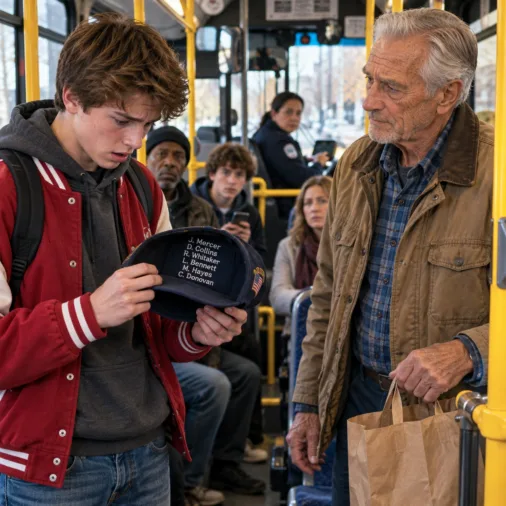
“Hey, bus boy,” the taller one called again as they moved down the aisle. “Where’s your veteran hat?”
His friend laughed and mimed snatching something from an invisible head.
Tyler’s hands clenched on his knees.
I watched his face and saw the same calculation I had seen the first day: audience, pride, fear, reaction. Only now he was the target.
He stood halfway.
“Sit down,” I said quietly.
He looked at me. “They’re not going to stop.”
“Maybe not.”
“You want me to just take it?”
“No.”
The taller boy leaned over the seat behind us. “What, grandpa’s your best friend now?”
Tyler spun around.
“Leave him out of it.”
“Or what?”
The challenge hung there.
Three weeks earlier, I suspect Tyler would have answered with another challenge. He might have shoved the boy, insulted him, or done something else designed to prove he could not be embarrassed. Instead, he looked at me once, breathed out, and sat back down.
Then he faced the boys.
“You saw the video,” he said.
“Everybody saw it.”
“Then you saw me act like an idiot. Congratulations.”
The shorter boy blinked.
Tyler continued. “If you want to make fun of me for it, go ahead. I already did worse to somebody else. I’m not giving you a second video.”
The taller boy opened his mouth, but nothing came out fast enough.
A few passengers smiled.
Tyler turned forward.
The boys moved toward the back and lost interest within two stops.
I waited until they got off before speaking.
“That was difficult,” I said.
“No kidding.”
“You handled it well.”
He stared out the window. “It still sucked.”
“Doing the right thing does not always feel good immediately.”
He gave me a sideways look. “You have a lot of old-man sentences.”
“I have had a lot of years to collect them.”
He laughed.
That became our second Saturday’s first lesson, though neither of us called it that. The rest came more slowly.
During the next two weeks, the video continued to circulate even after Mason’s original disappeared. It showed up under different captions. Some praised me. Some exaggerated the encounter until I barely recognized it. One post claimed I had been a decorated colonel. I had not. Another said Tyler had spat on me. He had not. A third said I had been wounded in combat and that the cap belonged to a dead brother. None of that was true.
I began to understand why Tyler looked sick every time someone mentioned the internet.
A lie does not need to be cruel to become dangerous. Sometimes praise can distort a person just as badly as ridicule.
One Thursday afternoon, a reporter named Hannah Pierce called the veterans center and asked Rosa if I would appear in a Veterans Day segment. Rosa gave me the message while I was restocking coffee.
“She says they want to focus on your response and restorative accountability,” Rosa said.
“They want a clean story.”
“They always want a clean story.”
“Life is badly organized for television.”
Rosa leaned against the counter. “You should consider it.”
I looked at her.
“That surprises me.”
“She says Tyler can participate if he and his mother agree.”
“No.”
“You did not even think.”
“I have been thinking about it since the first camera went up.”
Rosa folded her arms. “Sam, the story is already public. You cannot put it back in a bottle.”
“I know.”
“Then maybe you can correct the parts people got wrong.”
That stopped me.
I had spent days refusing interviews because I did not want to turn Tyler’s mistake into my spotlight. But the silence had created space for strangers to invent details.
“What would you say?” Rosa asked.
“The truth.”
“Which part?”
I smiled despite myself. “That is the problem, isn’t it?”
I called Hannah back.
I agreed to speak on one condition: Tyler would not be ambushed, and the segment would not identify his mother’s workplace or show his home. Hannah agreed immediately. She sounded relieved that I had rules rather than a refusal.
Before anything was scheduled, I called Karen.
She was quiet for a long time.
“I do not know,” she said. “He is finally sleeping again.”
“Then say no.”
“He might want to.”
“Then let him decide after he knows exactly what they are asking.”
Karen sighed. “Do you ever tell people what to do?”
“Constantly. I just try to know when I have earned the right.”
She laughed softly.
Tyler called me that evening.
“I want to do it,” he said.
“Why?”
“To fix it.”
“You cannot fix the internet.”
“I know.”
“Then why?”
A pause.
“Because people keep saying stuff I didn’t do. And people keep saying stuff about you that isn’t true. Mason gets messages calling him a coward. Leo’s parents made him delete every social account. My mom’s scared to wear her store badge outside work.”
“All true.”
“And because I keep thinking about what you said. Everybody knows fifty-two seconds. Maybe I should tell them what happened before and after.”
I leaned back in my chair.
“That is a better reason.”
We met Hannah at the veterans center the following Monday after school. The room she chose was small: two chairs, one camera, no dramatic flag wall. Tyler wore a plain gray sweater instead of his school jacket. I wore my cap.
Before the camera started, Hannah explained the questions she planned to ask. Tyler fidgeted with his sleeve.
“I can stop anytime?” he asked.
“Anytime,” she said.
“Even if I look stupid?”
“Especially then.”
He nodded.
The red light came on.
Hannah asked me what I remembered about the bus.
“I remember a crowded aisle and a teenager performing for his friends,” I said. “I also remember being irritated at myself because I had left my grocery bag on a seat too long.”
She looked surprised. “That is not in the viral clip.”
“No.”
“Why mention it?”
“Because people are easiest to hate when you remove every detail that makes the story inconvenient.”
She turned to Tyler.
“What were you trying to do?”
He looked at the camera and then away.
“I wanted my friends to laugh,” he said. “We were making dumb clips. I thought if I messed with somebody and they got mad, it would be funny.”
“Did you target Mr. Mercer because he was a veteran?”
“No. I mean, the hat gave me something to joke about. But I didn’t hate veterans. I barely thought about veterans.”
The honesty was not flattering. That was why I believed it.
“What changed when you looked inside the cap?” Hannah asked.
Tyler swallowed.
“I realized I was touching something I did not understand.”
He looked at me.
“And I realized he was not trying to beat me or embarrass me. He just wanted me to stop.”
Hannah asked about the public backlash.
This was the part I had worried about.
Tyler’s voice became tight.
“Some of it I deserved,” he said. “People saying I was rude? Yeah. I was. People saying I acted like a jerk? I did. But people sent my mom threats. They posted our building. They called her job. That didn’t teach me respect. It made me scared.”
Hannah turned to me. “Do you agree?”
“Yes.”
“So what did teach him respect?”
I did not answer immediately.
Then I said, “I do not know if I taught him anything. I think consequences opened the door. Work gave him time to decide whether to walk through it.”
Tyler looked down.
Hannah asked me about the names in the cap.
I told the truth there too. Two men had died in service. Four had lived different lengths of life afterward. The cap was about memory, not a simplified tale of six battlefield deaths.
“Does that make the bus moment less powerful?” she asked.
“It makes it more honest.”
The interview lasted twenty-five minutes. The station aired four.
To Hannah’s credit, the four minutes were fair.
The segment did something the original video had not. It showed Tyler as a person who had done something wrong rather than as a symbol of everything adults disliked about teenagers. It also showed me as an ordinary old man who volunteered twice a week and sometimes forgot grocery bags on seats.
The online response changed almost immediately.
Some people apologized for threatening him. Some did not. Some accused me of being too soft. One man wrote that Tyler needed “real consequences,” though he did not explain why three days of suspension, public shame, three Saturdays of work, and a conversation with his mother did not qualify.
The comment that stayed with me came from a woman whose profile picture showed her holding a toddler.
She wrote: I was ready to hate this kid. Then I remembered my son is going to be sixteen someday. I hope if he does something cruel, somebody makes him face it without deciding he can never become better.
I copied that sentence onto an index card and put it in my desk drawer.
On Tyler’s third Saturday, he arrived twenty minutes early.
He no longer needed directions. He tied on an apron, started the coffee, checked the biscuit timer twice, and asked Rosa what needed carrying.
Near noon, an older man entered wearing the navy-blue cap Tyler had donated.
Henry Cole was sixty-nine, thin, and quiet. He had lost most of his clothing in an apartment fire and had been staying with his sister while repairs were underway.
Tyler saw the cap first.
His hands stopped over a box of canned beans.
Henry noticed him staring.
“You like it?” he asked.
Tyler’s eyes met mine.
“Yeah,” he said. “It looks good.”
“Rosa gave it to me. Lost mine in the fire.”
Tyler nodded.
He did not tell Henry where it came from.
He did not take out his phone.
He went back to work.
That was the moment I began to trust that something had actually changed.
Not because he gave away a cap.
Because he finally did not need anyone to know he had done it.