She Grabbed Me at a Society Gala and Called Security—Then She Heard My Last Name Was Vance
Chapter 4 4/8
The Work Nobody Films
The Montgomery County Veterans Resource Center occupied a converted two-story brick building that had once been a neighborhood bank. The old teller windows were gone, but the vault door still stood in the basement, permanently open, and someone had taped a handwritten sign across it that said WINTER COATS instead of MONEY. Ellen used to laugh every time she saw it.
Tyler did not laugh at anything when he walked in.
The first person to greet him was Rosa Martinez, the center director, a retired Air Force logistics officer in her late fifties who could organize three hundred Thanksgiving meals with one clipboard and terrify a delivery company with one raised eyebrow.
“You’re Tyler,” she said.
He looked startled. “How do you know?”
Rosa pointed at his red jacket. “I have the internet too. Relax. Mr. Mercer told us you were coming to work, not to be displayed.”
Tyler glanced at me.
I had called Rosa the day before and asked her not to let anyone turn his visit into a public lesson. She had understood immediately.
“No speeches?” he asked.
“Only if you give me a reason,” Rosa said. “Kitchen is through there. Hairnet is on the counter.”
His eyes widened. “Hairnet?”
“Respect begins with food safety.”
I coughed to cover my laugh.
For the next two hours, Tyler did work so ordinary that no one would have clicked on a video of it. He carried cartons of milk. He wiped tables. He learned how to make coffee strong enough for Rosa’s approval. He stacked paper cups, opened boxes of oatmeal, and burned one tray of biscuits because he forgot to set the timer.
No one called him a hero. No one called him a disgrace.
People simply expected him to be useful.
At eight-thirty, the breakfast room filled. There was Nora Feldman, a seventy-eight-year-old former Army nurse who wore purple glasses and corrected everyone’s grammar. There was Luis Torres, forty-one, who had served in the Navy and now ran a small HVAC business. There was Kevin Brooks, twenty-nine, who had been in the National Guard and was studying accounting. There was George Hanley, eighty-four, who claimed every cup of coffee made after 1975 was too weak. Veterans were not a single type of person, and I watched Tyler realize that within twenty minutes.
He had expected old men in caps.
He got a room full of people who argued about football, school taxes, music, recipes, traffic, grandkids, and whether Rosa had secretly changed the brand of syrup.
At one table, Tyler set down a plate in front of a woman named Monique Carter. She was thirty-six, an Army veteran who had brought her six-year-old daughter because her childcare arrangement had fallen through.
The little girl looked at Tyler’s red jacket.
“Do you go to Roosevelt?” she asked.
“Yeah.”
“My cousin goes there.”
Tyler froze.
Monique noticed. “You all right?”
“Yeah.”
The girl squinted at him. “Are you the bus boy?”
His face turned the color of his jacket.
I started toward them, but Monique raised one hand before I could intervene.
“Keisha,” she said to her daughter, “we do not call people names from videos.”
“But that is him.”
“Maybe. He also has a name.”
The girl looked at Tyler. “What’s your name?”
“Tyler.”
“I’m Keisha.”
“Nice to meet you.”
Then she returned to her pancakes.
That was all.
Tyler stood there another second, surprised that the world had not ended.
Later, while we carried trash bags toward the back door, he said, “She knew.”
“Children usually do.”
“No, I mean her mom knew too.”
“Probably.”
“She didn’t say anything.”
“She corrected the thing that mattered in front of her daughter.”
He thought about that.
At ten, Rosa sent us downstairs to sort winter donations. Tyler opened boxes while I checked sizes and conditions. We found new socks, gloves, scarves, boots, and three coats that still had store tags attached. We also found a bag of clothing so worn that even Tyler looked offended.
“Why would somebody donate this?” he asked, holding up a sweatshirt with a broken zipper.
“Sometimes people confuse giving with throwing away.”
“That’s messed up.”
“Yes.”
He dropped it into the discard pile.
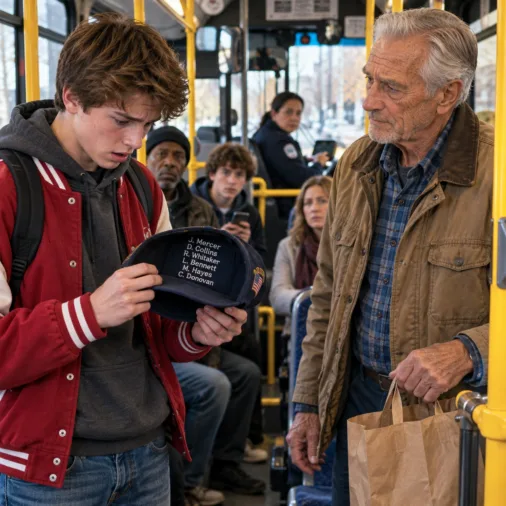
In the next box was a navy-blue cap.
Tyler looked at me.
“Funny,” he said.
“Not really.”
He pulled the new cap from his backpack—the one he had bought me—and set it beside the donated one.
“Who needs this?” he asked.
“Good question.”
Rosa found us a few minutes later. Tyler held up the cap.
“I bought this for Mr. Mercer, but he doesn’t need it. Can somebody here use it?”
Rosa inspected the front.
“We have a gentleman named Henry who lost his apartment in a fire last month. Most of his clothes were destroyed. He served in the Army. He hates asking for things.”
“Can I give it to him?”
“Not today. He’s not here.”
Tyler hesitated. “Can you?”
“Sure.”
He handed it over.
No one applauded.
Rosa put it in a labeled bag.
That mattered.
If someone had clapped, Tyler might have learned that kindness was another performance. Instead, the cap simply went where it was needed.
Around noon, we took a break on the back steps. The sun was bright but weak. Tyler drank a soda and stared at the parking lot.
“This is not what I thought it would be,” he said.
“What did you think?”
“I don’t know. Like… flags everywhere. People talking about battles.”
“There are flags upstairs.”
“You know what I mean.”
“I do.”
He twisted the soda can between his palms.
“Why don’t you tell war stories?”
“Sometimes I do.”
“Not on the bus.”
“You were a stranger holding my hat. That was not exactly the setting for chapter one.”
He smiled.
Then his expression changed.
“Did those six guys all die in the war?”
I looked toward the alley behind the building.
“No.”
He waited.
“Daniel and Marcus did not come home. Raymond came home but died young after years of health problems. Thomas died in a car accident. Eddie died of cancer in his fifties. Franklin lived until sixty-eight.”
Tyler frowned. “Then why are they all in the hat?”
“Because the cap is not a memorial to a single event. It is a reminder of the people who shaped the man who came home.”
He absorbed that.
“So you’re not wearing it because they all died for you.”
“No.”
“But the video makes it sound like that.”
“Yes.”
His face tightened. “Mason edited it.”
“I know.”
“You’re not mad?”
“I do not enjoy being turned into a simple character in someone else’s story.”
He stared at the can.
“That’s what I did to you first.”
I said nothing.
He looked at me. “Right?”
“Yes.”
His jaw moved as if he were chewing on the truth.
For the first time, I saw him understand the symmetry. He had reduced me to “old veteran on a bus.” The internet had reduced him to “disrespectful teenager.” Both versions contained facts. Neither contained a whole person.
That afternoon, we helped Rosa load donated blankets into a van. Tyler worked hard without being asked twice. When we finished, she handed him a bottle of water.
“You coming back next week?” she asked.
He looked at me.
“That’s up to him,” I said.
Tyler nodded. “Yeah.”
Rosa walked away as if he had told her the weather.
On the bus ride home, we sat side by side near the front. Tyler kept his phone in his pocket.
At Third Street, two boys from his school got on.
One spotted him immediately.
“Yo, bus boy!” he shouted.
The other laughed.
Tyler’s body went rigid.
The whole lesson was about to be tested sooner than I expected.