She Grabbed Me at a Society Gala and Called Security—Then She Heard My Last Name Was Vance
Chapter 6 6/8
The Empty Chair
The week before Veterans Day, Dr. Lewis invited me to Roosevelt High School.
My first instinct was to decline.
Schools often try to solve complicated human problems with assemblies, and assemblies have a way of turning real people into examples. I did not want to sit under bright gym lights while six hundred students were told to look at Tyler and learn what not to become.
Dr. Lewis promised that was not the plan.
“We have a long-standing Veterans Day program,” she said. “Students invite family members who served. The band plays. The history department presents. We had already scheduled it before the bus incident.”
“What do you want from me?”
“Five minutes.”
“About respect?”
“About whatever you think they should hear.”
I was silent.
Then she added, “Tyler asked if he could speak too.”
That changed things.
“What does he want to say?”
“He will not show me his notes.”
“That is encouraging.”
“Why?”
“Because if he were trying to impress you, he would have turned them in already.”
I agreed to attend.
The morning of the program, the gym smelled like floor polish and brass instruments. Folding chairs filled the court. A row of reserved seats had been placed near the front for veterans and their families. On the stage, the school had arranged a flag, a podium, and one empty chair beside a small table.
Tyler stood near the bleachers wearing a dark button-down shirt. When he saw me, he walked over.
“You came.”
“You invited me.”
“I thought you might change your mind.”
“I considered it.”
“That sounds like you.”
I smiled.
He looked toward the empty chair onstage. “What is that for?”
“A remembrance table, I think.”
He nodded.
Mason and Leo approached from behind him. I had seen them only once since the bus, at the television interview. Mason had apologized to me privately for filming and posting the clip. Leo had said less, but he had stopped laughing much earlier than Mason on the bus, and I suspected shame had been working on him in silence.
“Mr. Mercer,” Mason said. “Good to see you.”
“You too.”
Leo nodded. “Sir.”
“Sam is fine.”
He looked alarmed by the idea, so I let him keep sir.
The program began with the school band. Students fidgeted at first, then settled when family members who had served were introduced. There were veterans from several generations in the audience: a grandmother who had served in the Navy, a young father in an Air Force jacket, a custodian who had been in the Marines, a math teacher who had served in the Army Reserve.
I watched Tyler watching them.
Before the bus incident, veteran had been a category to him. Now he kept seeing faces.
Dr. Lewis introduced me near the middle of the program.
The applause was louder than I wanted.
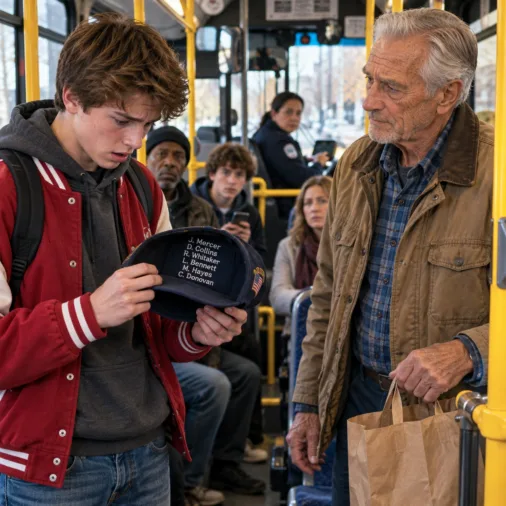
I walked to the podium wearing my old cap.
For a moment, I looked at hundreds of young people who had all been children recently and would all be adults sooner than they understood.
I had written a speech.
I folded it and put it in my pocket.
“I was asked to say something about respect,” I began. “That is a dangerous topic for an old man because we can make it sound like respect means young people should be quiet while we talk.”
A ripple of laughter crossed the gym.
“So let me start somewhere else. Respect is not fear. It is not obedience. It is not pretending older people are always right. We are not. I have had seventy-three years to make mistakes, and I have used the opportunity generously.”
More laughter.
I looked at Tyler.
“Respect is the decision to remember there is a whole person in front of you, especially when it would be easier to reduce them to one thing. Their age. Their clothes. Their job. Their worst mistake. Their uniform. Their politics. Their accent. Their fifty-two-second video.”
The gym became quiet.
“I wore this cap on a bus a few weeks ago. A teenager took it from me. That was wrong. But the internet then tried to take that teenager’s entire future and fit it inside the same moment. That was wrong too.”
I heard someone shift in the front row.
“The names inside this cap remind me of men who changed my life. Some died young. Some lived long enough to become old and annoying, which I consider a privilege. None of them were perfect. Neither am I. Memory should make us more human, not less.”
I stepped away from the podium.
“Thank you.”
The applause was softer this time.
I preferred it.
Dr. Lewis returned to the microphone and introduced Tyler.
A murmur moved through the students.
He walked to the podium with a folded piece of paper in his hand.
He unfolded it.
Then he looked at me.
Then at his mother, who sat three rows back after rearranging her work schedule to attend.
Then he looked at the students.
“My principal asked if she could read this first,” he said. “I said no.”
Students laughed. Dr. Lewis shook her head but smiled.
“I wrote three versions,” Tyler continued. “The first one sounded like a school apology. The second one sounded like I was trying to make people feel sorry for me. Mr. Mercer would hate both.”
I did not deny it.
“So I’m just going to say what happened.”
He gripped the sides of the podium.
“I saw an old man on a bus and decided he was content. That’s the truth. I did not know him. I didn’t care if he was having a good day or a bad day. I cared if my friends laughed. When he told me not to touch his hat, I touched it anyway because stopping would have made me feel weak.”
The gym was silent.
“I thought respect was something adults demanded when they ran out of better arguments. Then I spent three Saturdays at the veterans center.”
He glanced at Rosa, who was seated beside me.
“Nobody there asked me to worship veterans. They asked me to make coffee, carry boxes, listen, clean up, show up on time, and stop making everything about me.”
Rosa whispered, “That last one was me.”
I smiled.
Tyler continued.
“I also learned something else. After the video went viral, strangers did to me what I did to Mr. Mercer. They decided one thing about me was the only thing worth knowing. Some people threatened my mom. Some posted where we lived. I wanted to say that made me the victim and erased what I did. It doesn’t.”
Karen covered her mouth.
“I can be wrong and still be a person. Mr. Mercer can be a veteran and still just be a guy who likes pie and weak coffee.”
“Strong coffee,” I called.
The gym laughed.
Tyler smiled briefly.
“My point is, I’m sorry. Not because I got caught. Not because people were mad. I’m sorry because I made another human being smaller so I could look bigger in front of my friends. That’s not the person I want to be.”
He looked at the paper.
Then he folded it without reading the rest.
“I don’t know if this fixes anything. Probably not. But I’m going back to the center Saturday even though my three Saturdays are done. That’s all.”
He stepped away.
The students stood.
At first only a few. Then more.
Tyler looked terrified.
I stayed seated.
Not because I was unimpressed.
Because I wanted him to understand that the speech did not need a standing ovation to be true.
When the applause ended, he returned to his seat beside his mother. Karen hugged him. He let her.
After the program, a freshman approached me near the stage.
“Mr. Mercer?”
“Yes?”
He pointed to the empty chair.
“Why leave a chair empty if respect is about seeing people?”
It was a good question.
I looked at the small remembrance table and then at Tyler, who was helping Mason stack programs.
“Because sometimes absence is one of the things we have to learn to see,” I said.
The boy nodded slowly.
That afternoon, Tyler rode the Number 18 bus home with me.
This time, when we boarded, he waited for me to choose a seat first.
I pointed to two empty spots near the back.
“You’re not going to make me sit in the front because I’m old?” I asked.
He grinned. “Respect is not making assumptions, remember?”
“Careful. You may be learning.”
We sat down.
At the next stop, an elderly woman boarded carrying two heavy shopping bags.
Before I could move, Tyler stood and offered her his seat.
She thanked him.
He did not look at me for approval.
He did not look around to see who noticed.
He simply held the rail and kept talking about a history test he was certain had been designed to destroy him.
I looked out the window so he would not see me smile.