She Grabbed Me at a Society Gala and Called Security—Then She Heard My Last Name Was Vance
Chapter 2 2/8
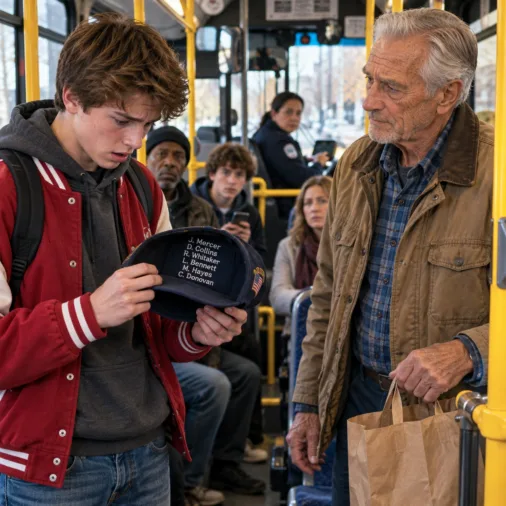
The Names Under the Brim
By the time I reached home, I had decided not to tell anyone about the bus.
That was not because I was ashamed. It was because I had learned, over decades, that most ugly moments become uglier when everyone carries them to a different room and retells them with sharper edges. I had made my point. Tyler had returned the cap. No one had been hurt. I wanted to heat soup, eat half the apple pie, and watch the evening news without turning one foolish teenager into the center of my life.
I lived alone in a small brick house on a quiet street lined with maple trees. Ellen had died four years earlier after forty-six years of marriage. The house still carried her in ordinary places: the chipped blue bowl she refused to throw away, the pencil marks inside the pantry door where we measured our daughter Rebecca as she grew, the hook by the back door where Ellen used to hang her gardening hat. Grief, I had discovered, did not live only in photographs. It preferred useful objects.
I set the grocery bag on the counter and removed my cap.
The stitching under the brim had not been damaged.
I traced the names once with my thumb.
Daniel. Marcus. Raymond. Thomas. Eddie. Franklin.
For years, I had avoided talking about them in public because people often wanted war stories to fit into neat categories. They wanted bravery without fear, sacrifice without confusion, patriotism without grief. Real memory was messier. Some of the men whose names I carried had been funny, selfish, generous, stubborn, scared, reckless, tender, annoying, and brave, sometimes all before lunch. Remembering them honestly felt more respectful than turning them into statues.
My phone rang while I was cutting the pie.
Rebecca’s name appeared on the screen.
“Dad,” she said before I could say hello, “what happened on the bus?”
I closed my eyes.
“How do you know about that?”
“Because somebody sent me a video and asked if the man in it was you.”
I looked at the cap on the counter.
“How many people have seen it?”
“Enough that I’m asking.”
“That is not a number.”
“Forty-eight thousand when it reached me.”
I set the knife down.
“What?”
“And that was twenty minutes ago.”
Rebecca lived in Cincinnati and worked as a nurse manager. She had inherited Ellen’s ability to sound calm when she was worried and my ability to become bossy when scared. I could hear both in her breathing.
“Are you okay?” she asked.
“I’m fine.”
“Did he touch you?”
“He took my cap.”
“Dad.”
“He gave it back.”
“That is not the point.”
“It is one of the points.”
She exhaled sharply. “The comments are awful.”
“About me?”
“About the boy.”
That made me pause.
“What are they saying?”
“You do not need to read them.”
“Then tell me.”
“No.”
“Rebecca.”
“Dad, grown adults are talking about ruining his life. They found his school from the jacket. Some people think they found his name. Someone posted what they claim is his mother’s workplace.”
The pie no longer looked appetizing.
“Send me the video.”
“I don’t want you in that mess.”
“I’m already in it.”
A minute later, a link arrived.
The video was fifty-two seconds long. It had been posted from an account I did not recognize under the caption: OLD VET HUMILIATES KID WITHOUT RAISING HIS VOICE.
I hated the caption immediately.
No one had humiliated Tyler. At least that had not been my intention. I had tried to stop him from humiliating himself.
The clip began after he took my cap, which meant viewers never saw the first several minutes of joking, the crowded bus, the seat I had failed to clear, or the young mother I had given it to. They saw Tyler holding my cap, Denise demanding he return it, and me asking him to read the names stitched inside. The final twenty seconds showed his face changing as I explained why the names were there.
The camera was steady enough that I knew Mason had filmed it.
I watched it twice.
Then I opened the comments.
Rebecca had been right.
There were kind messages. There were veterans sharing names of people they remembered. There were parents saying they hoped their children would learn from the clip. There were younger people pointing out that Tyler had looked genuinely ashamed. But mixed among them were thousands of comments demanding punishment.
Expel him.
Make him unemployable.
Find his parents.
Post his address.
Somebody should teach that punk the old-fashioned way.
I stopped reading.
My stomach tightened in a way it had not on the bus.
Public anger is a dangerous animal because every person who feeds it thinks they are only adding one small piece.
I called Rebecca back.
“I need Mason’s account,” I said.
“Why?”
“I’m going to ask him to take the video down.”
“It’s already everywhere.”
“Then I’m going to ask him anyway.”
“Dad, you cannot control the internet.”
“No. But I can control whether I help it destroy a child.”
She went quiet.
“He stole your cap,” she said finally.
“He made a stupid choice.”
“He tried to humiliate you.”
“Yes.”
“And you’re worried about him?”
“I’m worried about what happens when people confuse accountability with revenge.”
Rebecca knew better than to argue when I used that tone. She sent me the account name.
I wrote Mason a short message.
My name is Samuel Mercer. I am the man in your bus video. Please remove the original post. Tyler needs to answer for what he did, but strangers do not need his school, his mother’s job, or his address. If you want to show respect for me, start there.
I did not expect a reply.
Ten minutes later, I got one.
Mr. Mercer, I’m sorry. I already deleted mine. Someone screen recorded it before I did. Tyler is freaking out. I didn’t mean for this to happen.
I stared at the words.
I believed him.
Not because teenagers are always innocent. They are not. Neither are adults. I believed him because regret has a particular shape. It is usually less dramatic than fear and more specific than excuses.
I typed back.
Tell Tyler to stop reading comments. Tell him to tell his mother what happened if she does not know. And tell him not to contact me tonight.
Mason responded with one sentence.
He says everybody hates him.
I looked at the cap again.
For a moment I was nineteen years old, thousands of miles from home, convinced one mistake could define the rest of my life. I remembered a sergeant named Franklin Shaw sitting beside me after I froze during a chaotic night exercise and telling me, “Mercer, shame is only useful if it points you toward the next right thing.”
Franklin’s name was the last one inside my cap.
I wrote one more message.
Everybody does not know him. They know fifty-two seconds. He still has to decide what the next fifty years say.
I put my phone face down.
The next morning, two local television stations called me before eight. I declined both interviews. A radio host left a voicemail. A national website emailed Rebecca. Someone from a veterans organization in another state asked permission to repost the clip on its page.
I said no to all of them.
At nine-thirty, the principal of Roosevelt High School called.
“Mr. Mercer, my name is Dr. Janice Lewis,” she said. “I’m sorry to bother you. I believe three of our students were involved in an incident with you yesterday.”
“Yes.”
“I want you to know we are handling it.”
“What does handling it mean?”
There was a pause.
“We have policies regarding student conduct, especially when school clothing identifies the school in public.”
“That still does not answer me.”
She sighed. “Tyler Reed has been suspended for three days while we review the situation. The other two students are receiving consequences for recording and encouraging it.”
I leaned against the kitchen counter.
“Do you know why Tyler did it?”
“Excuse me?”
“Do you know what he was trying to prove?”
“No. We have not completed our interviews.”
“Then maybe complete them before you decide what lesson you want him to learn.”
Her voice became careful. “Mr. Mercer, I assure you our school takes respect for veterans very seriously.”
“I hope you take respect for teenagers seriously too.”
That surprised her.
I told her about the comments, the posted workplace, the threats disguised as patriotism. I told her that I wanted Tyler held responsible, but I did not want an assembly where adults applauded themselves for shaming him in return.
“What would you suggest?” she asked.
I had not expected the question.
My eyes went to the handwritten calendar on the refrigerator. Saturday was circled in blue because I was scheduled to serve breakfast at the Montgomery County Veterans Resource Center.
An idea arrived before I could talk myself out of it.
“Ask him if he wants to spend three Saturdays working with me,” I said.
“Working where?”
“At the veterans center.”
She was silent.
“That sounds like community service.”
“It is not a sentence,” I said. “If he comes, he comes because he agrees to. No cameras. No school newspaper. No social media. He does the work nobody films.”
“And if he refuses?”
“Then he refuses. Respect taught under threat is usually just obedience.”
Dr. Lewis asked whether I was certain.
I looked at Franklin’s name under the brim of my cap.
“No,” I said. “But I think it might be the next right thing.”
That afternoon, someone knocked on my front door.
I expected Rebecca, even though she had not said she was coming.
Instead, when I opened it, Tyler Reed was standing on my porch with his mother.
And in his hands was a new navy-blue veteran cap he had clearly bought that morning.