She Grabbed Me at a Society Gala and Called Security—Then She Heard My Last Name Was Vance
Chapter 7 7/8
What the Camera Could Not Teach
Tyler kept coming to the veterans center.
At first he came every Saturday. Later, when basketball season started and his mother changed shifts at the grocery store, he came twice a month. No one tracked his hours after the required three visits because there were no required hours left to track.
That was important.
Choice reveals things punishment cannot.
By January, he knew which cabinet held the extra gloves and which coffee George Hanley complained about least. He knew Monique’s daughter liked strawberry syrup and that Nora Feldman would challenge anyone who used the word literally incorrectly. He knew Henry Cole had moved back into his repaired apartment. He knew Rosa hid emergency bus passes in the second drawer of her desk and pretended not to notice when people were too proud to ask for one.
He also learned that veterans could be difficult.
One Saturday, George snapped at him because the oatmeal was too thin. Tyler looked at me as if this violated the moral contract.
“I thought I was supposed to respect him,” he whispered.
“You are.”
“He’s being rude.”
“Also true.”
“What do I do?”
“Respect does not mean volunteering to be mistreated. Tell him the oatmeal is what it is and offer toast.”
Tyler approached George carefully.
“Mr. Hanley, I can get you toast, but I can’t make the oatmeal un-cooked.”
George glared at him.
Then he laughed so hard he coughed.
“Fair enough, bus boy.”
Tyler froze.
George’s face changed immediately. “Too far?”
“A little.”
“Sorry.”
“All right.”
That exchange taught Tyler more than a poster about mutual respect ever could have.
Adults could apologize to teenagers.
Veterans could be wrong.
Boundaries did not cancel respect.
Forgiveness did not erase accountability.
I watched him collect these ideas one ordinary morning at a time.
In February, Karen invited me to dinner.
I almost said no because I did not want our connection to become a sentimental arrangement where I replaced some missing family role. Tyler had a mother. He had teachers. He had a life that existed before I entered it and would exist after me.
Karen insisted the invitation was simple.
“Lasagna,” she said. “Nothing symbolic.”
“That is exactly what symbolic lasagna would say.”
She laughed. “Seven o’clock.”
Their apartment was modest and clean, on the third floor of a building that had appeared online during the worst week of the backlash. Seeing it in person made those old posts feel uglier. This was not a target. It was a home. There were shoes by the door, coupons clipped to the refrigerator, a cracked lamp beside the couch, school photos on the wall.
Mason and Leo were there too.
That surprised me.
“We’re working on a media class project,” Tyler explained.
I narrowed my eyes. “Should I be worried?”
“No phones on you, I swear.”
Their project was about how short video clips change meaning depending on what comes before and after. They planned to use staged scenes, not the bus footage.
Mason looked uncomfortable.
“I kind of caused all of this,” he said.
Tyler shook his head. “I caused the thing you filmed.”
“I posted it.”
“Yeah, and that was stupid.”
“Thanks.”
“But I grabbed the hat.”
Leo raised both hands. “And I told him to do it too.”
“No,” Mason said. “I did.”
“You both did,” Tyler replied.
They looked at me as if expecting a ruling.
I cut a piece of lasagna.
“You three seem to have distributed responsibility without my help.”
Karen smiled.
After dinner, Tyler showed me the final slide of their project. It contained one sentence:
A CAMERA RECORDS WHAT HAPPENED. IT DOES NOT AUTOMATICALLY EXPLAIN WHAT IT MEANT.
“That is good,” I said.
“Too old-man?” Tyler asked.
“Extremely.”
He grinned.
Spring arrived slowly. The viral video disappeared from daily conversation, though it never vanished completely. Every few weeks someone recognized one of us. Sometimes a stranger thanked me. Sometimes they told Tyler they were glad he had “turned his life around,” which annoyed him because, as he pointed out, he had not been running an organized crime ring before the bus.
One afternoon in April, he asked me something I had been expecting for months.
“Can I see the names again?”
We were sitting on the back steps of the veterans center eating sandwiches.
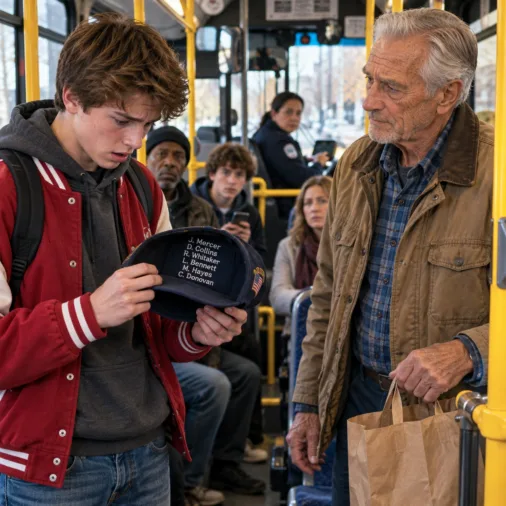
I removed my cap and handed it to him.
He turned it over carefully.
The white thread had faded slightly around Franklin’s name.
“You ever think about adding Mrs. Mercer’s name?” he asked.
I looked at him.
“Why?”
“She’s part of why you wear it.”
I took the cap back.
Ellen’s absence moved through me, familiar and sharp.
“I have thought about it.”
“Why don’t you?”
“Because she is not connected to my military service in the same way.”
“She sewed the names.”
“That is true.”
He waited.
Teenagers are often accused of impatience, but Tyler had learned silence from veterans who needed time before answering.
Finally I said, “Maybe I have been too strict about what the cap is allowed to mean.”
He nodded, then took another bite of his sandwich.
That evening, I opened Ellen’s sewing box for the first time since her funeral.
The hinges squeaked. Inside were spools of thread, pins, thimbles, measuring tape, and the small embroidery scissors she never allowed me to use for anything else. At the bottom was a card with six names written in her handwriting—the list she had copied before stitching them into my cap.
I sat at the dining table for a long time.
Then I turned the card over.
On the blank side, I wrote ELLEN MERCER.
I did not sew it into the cap that night. My hands were not steady enough for embroidery, and I could almost hear her telling me not to ruin perfectly good fabric pretending I knew what I was doing.
The next Saturday, Nora did it for me.
She chose gold thread.
“White is for the men,” she said. “Gold for the woman smart enough to marry you.”
“That seems unnecessarily judgmental.”
“It is accurate.”
Tyler watched from across the table as she stitched Ellen’s name beneath the others.
When she finished, I turned the cap over.
Seven names.
For years I had believed memory meant preserving things exactly as they had been. Tyler had helped me understand something else. Honest memory can grow without betraying the past.
I put the cap on.
“How’s it look?” I asked.
Tyler shrugged. “Still old.”
“Get out.”
He laughed.
In May, nearly six months after the bus incident, Denise Alvarez walked into the veterans center during breakfast.
She was off duty and carrying a bakery box.
“Peace offering,” she announced.
Rosa opened it. “For what?”
“For all the times Sam complains my bus is late.”
“I complain accurately.”
Denise hugged me, then spotted Tyler behind the coffee urn.
“Well,” she said. “Look at you.”
He stiffened for half a second.
Then relaxed.
“Hi, Ms. Alvarez.”
“You still stealing hats?”
“No, ma’am.”
“Good. Paper cups are less trouble.”
She poured coffee.
We laughed.
It struck me then how ordinary Tyler had become in this place.
That was the real victory.
Not a viral redemption story. Not a dramatic transformation montage. He had simply become a teenager people knew well enough to tease, correct, trust, and expect things from.
The internet had once flattened him into a villain.
Community had given him dimensions back.
A week later, Tyler called me after dark.
His voice sounded wrong.
“Mr. Mercer?”
“Yes?”
“Can you come to the bus station?”
“What happened?”
“I didn’t do anything. I swear.”
That sentence tightened my chest.
“Where are you exactly?”
“Main terminal. By the ticket machines.”
“Is your mother there?”
“No. She’s at work. I called her but she can’t leave yet.”
“What happened?” I asked again.
He hesitated.
Then he said, “There’s a kid here. Maybe twelve. Some older boys took his backpack. Everybody’s filming. Nobody’s helping.”
I was already reaching for my coat.